How to select the Lithium battery capacity for home energy storage system?
author: SVC ENERGY
2024-08-12

How to select the battery capacity in household energy storage systems? How to match the battery capacity with the load?
With the advent of the zero-carbon era and the smart era, people are becoming more and more dependent on electricity and more and more inclined to use green electricity. At the same time, the scenarios for using energy storage are becoming more and more extensive. The popularity of photovoltaic power generation, the maturity of lithium battery technology and large-scale production also provide a key prerequisite for energy storage to enter ordinary people's homes.
In order to meet customers' various needs for energy storage systems, various energy storage equipment manufacturers have also put forward various solutions. SVC ENERGY has launched different application solutions such as industrial and commercial energy storage systems, household energy storage systems, and telecommunications base station energy storage for different application scenarios, and has launched a matching series of energy storage products. At the same time, SVC ENERGY also provides customers with stacked installation, modular all-in-one machines, and integrated products with multiple power/energy combinations. Various forms of liberalized energy matching solutions.
In many families, energy storage has also become a must-have for energy management. Energy storage capacity plays a key role in household energy utilization or electricity bill expenditure, so how to choose energy storage equipment and how to match battery capacity have become the most concerned links.
So, in the home energy storage scenario, how can we choose the best Lithium battery capacity solution in the fastest and most direct way?
For grid-connected energy storage, the main purposes can generally be divided into three categories: photovoltaic self-use (high electricity prices or no subsidies), peak and valley electricity prices, and backup power supply (unstable grid or important load).
(1) Improving the photovoltaic self-use rate
The main purpose of this scenario is to install a photovoltaic energy storage system to reduce electricity expenses because of high electricity prices or low photovoltaic grid-connected subsidies (no subsidies). Therefore, the photovoltaic system power can be stored for use at night in addition to daytime use. Without considering the grid stability factor, the off-grid operation of the system is not considered.
We divide the household electricity consumption into daytime electricity consumption (photovoltaic high power generation period) and nighttime electricity consumption (photovoltaic low power or no power period). According to the above purpose, the most ideal state should be that the photovoltaic power generation meets the daytime electricity consumption, and after storage, it can just meet the nighttime electricity consumption. That is, the effective capacity of the battery should be approximately equal to the photovoltaic power generation minus the daytime electricity consumption. However, this is only an ideal state. In order to avoid redundant battery capacity (to avoid not being able to consume it all at night), we also need to ensure that the effective power of the Lithium battery does not exceed the power consumption at night.
This requires us to have a relatively accurate grasp of the household power consumption pattern and to be familiar with the energy storage system's setting rules for power supply priority.
For the simplest example, a family has installed a 5kW photovoltaic system with a daily power generation of about 17.5kWh. The average daily power consumption of the family is about 20kWh, of which the average power consumption during the day is 5kWh and the average power consumption at night is 15kWh. Then, the effective power of the Lithium battery should be approximately equal to 17.5-5=12.5kWh, and this also meets the condition of not exceeding the power consumption at night (12.5kWh≤15kWh). Therefore, the best battery effective power for this family is 12.5kWh.
(2) Peak shaving and valley filling to reduce electricity bills
The main purpose of this scenario is to charge the Lithium battery when the electricity price is low during the day and discharge the Lithium battery when the electricity price is high at night, thereby reducing the overall electricity bill.
We divide the household electricity consumption into daytime electricity consumption (dry season) and nighttime electricity consumption (peak season). In this scenario, the most ideal state is "the Lithium battery is charged with the remaining power and the grid after the photovoltaic power supply load is used during the day, and the Lithium battery power just meets the nighttime (peak season) use". That is, the effective capacity of the Lithium battery is approximately equal to the household's nighttime electricity consumption. However, the Lithium battery capacity calculated based on nighttime electricity consumption is only a maximum demand value. Considering the battery cost, it is generally necessary to comprehensively consider the photovoltaic system capacity, battery investment and electricity price savings to determine an optimal ratio. At the same time, it is also necessary to meet the requirement that the battery discharge time is not longer than the nighttime electricity consumption.
Similarly, taking the example of the family above, a family installed a 5kW photovoltaic system, with an average daily electricity consumption of about 20kWh and a nighttime electricity consumption of 15kWh (assuming that the peak and valley season of electricity prices is 5 hours from 17:00 to 22:00). According to calculations, the best investment return point is that the effective capacity of the battery covers 2/3 of the household's nighttime electricity consumption. Then, the effective power of the battery should be approximately equal to 15*2/3=10kWh. At this time, the battery is approximately 10kWh/5kW=2h, which is less than or equal to the nighttime power consumption of 5h. Therefore, the optimal effective power of the battery for this family is 10kWh.
(3) As a backup power source in areas with unstable power grids
When the energy storage system is used as a backup power source, it is mainly used in areas with unstable power grids or in situations with important loads. For example, basic lighting, refrigerators, desktop computers, etc. in homes; data rooms in commercial places, important equipment in industrial places, lighting and ventilation equipment in breeding places, etc.
When designing the Lithium battery capacity for the main purpose of backup power supply, the main consideration is the power required for the Lithium battery to supply the important load alone when it is off the grid for the longest time (the expected longest power outage time), including the need to consider the situation where there is no PV at night.
In this scenario, the Lithium battery capacity is relatively easy to calculate. You only need to list all the important loads and calculate the power consumption of all loads during the longest power outage time to preliminarily determine the battery capacity.
Take an important commercial place as an example. The important load is 10 cabinets in the data room, and the power consumption of each cabinet is 3kW. The longest power outage is expected to last about 4 hours. According to calculations, the effective capacity of the Lithium battery in this project should be 10*3kW*4h=120kWh. Therefore, the best Lithium battery effective capacity for this industrial and commercial project can be 120kWh.
The above three situations are the most common requirements for installing grid-connected energy storage systems, and there are also rules to follow when selecting Lithium battery capacity. However, in actual applications, two or more requirements may overlap, which requires us to be able to analyze them specifically according to the requirements and finally sort out the best battery capacity.
In addition, in the above analysis, we mentioned the effective power of the Lithium battery, and when actually selecting the Lithium battery, we also need to consider the impact load of the load, the DOD (depth of discharge) of the battery, the system efficiency loss, the performance of the energy storage equipment, the expected investment return and other situations. Therefore, when choosing the Lithium battery capacity, it is necessary to consider the power of the entire family or the scenario as a whole system, and it is also particularly important to choose the best equipment and system integration supplier.
SVC Energy is an energy storage company founded in 2022. We have 20 years of experience in the UPS industry. We provide energy storage solutions for homes and businesses. We design and build our own products and also work with partners to build complete solutions. Our solutions cover a wide range of products, including solar panels, inverters, Lithium battery packs, storage cabinets, charging piles, and heat pumps. SVC Energy employs over 400 people, 30% of whom are in R&D. Our R&D center and plant are in Foshan, China, and we have sales offices and technical support centers in China, Germany and South Africa. All of our products have passed quality inspections and received international safety certificates. SVC Energy has built an extensive customer network around the world.
Why choose SVC 48V Lithium iron battery for Telecom base station?
How do you recommend suitable products or solutions to your customers?
Related Article
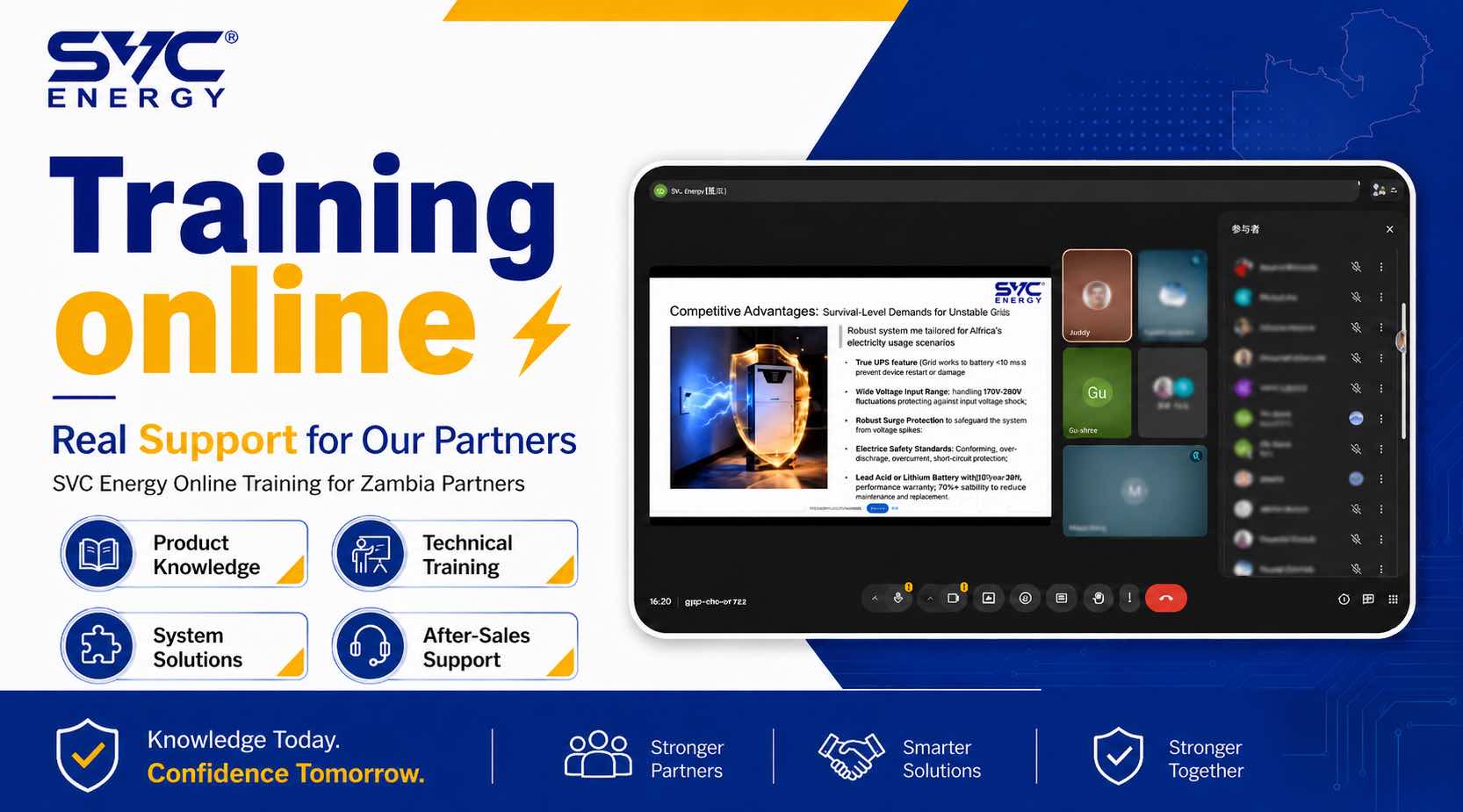
SVC Energy recently held an online training session for partners in Zambia, sharing product knowledge, technical guidance, solar backup system solutions, and after-sales support. This training reflects SVC Energy’s commitment to supporting partners not only with solar inverters and lithium batteries, but also with long-term service, practical knowledge, and market confidence.
SVC Energy Online Training for Zambia Partners: Real Support Beyond Product Supply

SVC Energy successfully provided off-grid solar energy systems for 6 schools in Zambia, helping improve access to reliable electricity for educational environments through 3.6kW inverters and 2.56kWh lithium battery solutions.
SVC Energy Supports 6 Schools in Zambia with Solar Power Systems

SVC Energy attended the Zambia National STEM Innovation Hub Fundraising Gala Dinner, joining discussions on education, technology development, and the importance of reliable solar energy solutions for Zambia and Africa.
SVC Energy Joins Zambia STEM Gala Dinner, Supporting Innovation Through Reliable Energy Solutions
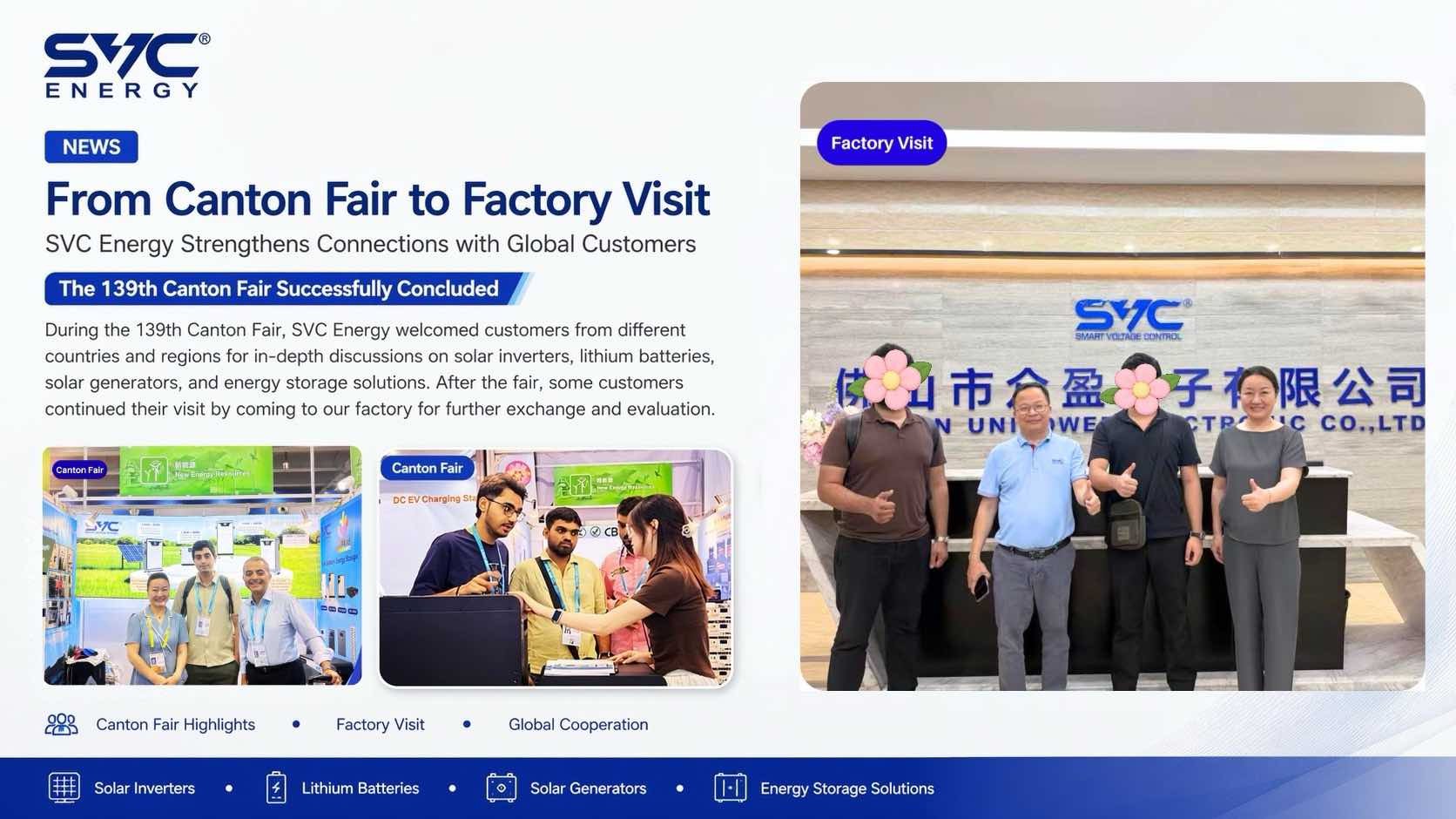
After the successful conclusion of the 139th Canton Fair, SVC Energy continued in-depth communication with international customers through factory visits, further strengthening trust and exploring future cooperation in solar inverters, lithium batteries, solar generators, and energy storage solutions.
From Canton Fair to Factory Visit: SVC Energy Strengthens Connections with Global Customers