Can a Kenyan EV Owner Use Rooftop Solar and a Home Battery Without Oversizing the System?
Can a Kenyan EV Owner Use Rooftop Solar and a Home Battery Without Oversizing the System?
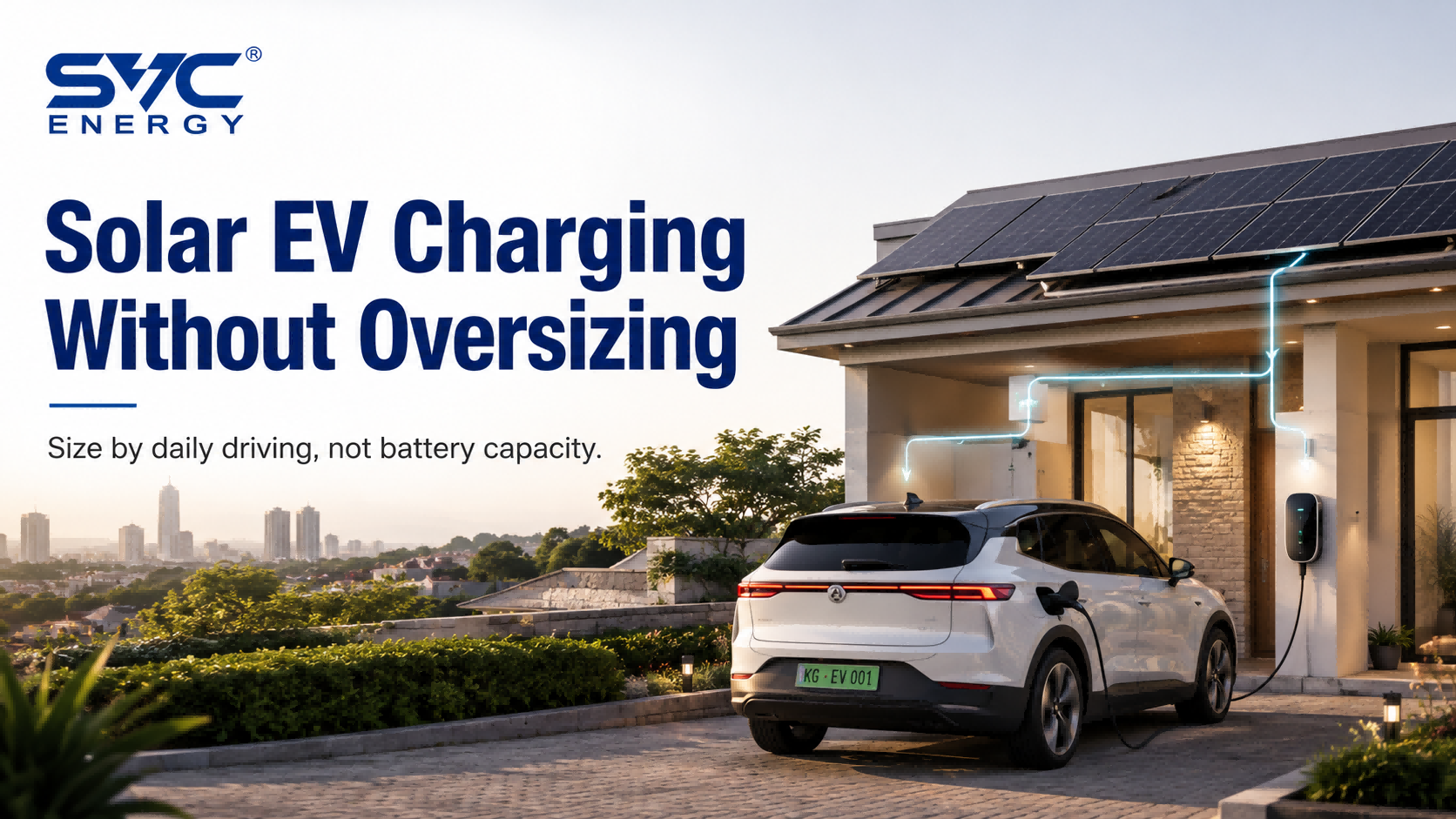
Yes. A Kenyan EV owner can reduce charging costs with rooftop solar and a home battery, but the system should be sized from daily driving energy and charging time—not the EV battery’s full capacity.
Quick Answer
In many homes, rooftop solar should cover typical daily kilometres, while a stationary battery is added only when charging after sunset, maintaining household backup or limiting grid demand. Measure daily EV energy first, then size PV, battery and inverter power separately.
Kenya Power began transitioning EV-charging customers to its e-mobility tariff in June 2026, highlighting the importance of metering and real charging-demand data. Homeowners should confirm the applicable meter and tariff arrangement directly with Kenya Power before calculating savings. Source reference: Kenya Power e-mobility update.
Start With Daily Driving, Not the EV’s Full Battery
An EV may have a 50 kWh or 70 kWh traction battery, but most owners do not recharge it from empty every day.
Estimate daily charging energy using:
Daily Charging Formula
Daily driving distance × vehicle energy consumption ÷ charging efficiency
Assume:
- Daily driving: 40 km
- EV consumption: 0.17 kWh per kilometre
- Charging efficiency: 90%
Worked Example
40 km × 0.17 kWh/km = 6.8 kWh
6.8 kWh ÷ 0.90 = approximately 7.6 kWh from the charger
The solar system should therefore be planned around roughly 7.6 kWh of daily charging—not the full EV battery capacity. This is a calculation example; actual consumption depends on the vehicle, traffic, speed, air conditioning, terrain and driving style.
How Much Additional Rooftop Solar May Be Needed?
A preliminary PV estimate can use:
Preliminary PV Formula
Daily EV charging energy ÷ peak-sun-hours ÷ system efficiency factor
Using an assumed five peak-sun-hours and an 80% system factor:
PV Estimate
7.6 kWh ÷ 5 ÷ 0.80 = approximately 1.9 kWp of additional solar
This is only an initial estimate. Roof direction, shading, local weather, panel temperature, inverter clipping and existing household loads must be checked before installation.
If the house already consumes most of its daytime solar production, the EV capacity must be added on top. If the vehicle is regularly parked at home during the day, direct solar charging can reduce the need for a large stationary battery.
When Is a Home Battery Useful?
A home battery is most useful when:
- The EV returns home after sunset
- Daytime solar would otherwise be exported or wasted
- The household needs backup during grid interruptions
- The owner wants to reduce evening grid demand
- Charging must continue during an outage
A battery may add little value if the EV is normally at home and charging during strong daylight. In that situation, adding more PV and using smart daytime charging may cost less than buying a large stationary battery.
How Large Should the Stationary Battery Be?
First decide how much EV energy must be shifted from daytime to night.
Assume the owner wants to shift 7.6 kWh. If the stationary battery is operated at 80% usable depth of discharge and the battery-to-load path is approximately 90% efficient:
Required Nominal Battery
7.6 kWh ÷ 0.80 ÷ 0.90 = approximately 10.6 kWh
This indicates that a nominal battery around 10.5–11 kWh may cover approximately one typical charging session under these assumptions, but it leaves little allowance for household backup loads.
SVC Battery Options
SVC’s Phoenix 10.5 kWh battery has a documented nominal configuration of 51.2 V / 205 Ah. For households needing more reserve for lighting, refrigeration, internet and EV charging, the SVC 16.08 kWh LiFePO4 battery provides a larger nominal energy base. Neither battery should be assigned a guaranteed runtime without the actual EV charger, household load and operating settings.
Do Not Confuse Battery Energy With Inverter Power
Battery capacity is measured in kWh. EV charger and inverter output are measured in kW.
A home may have enough battery energy but an inverter that cannot support the charger’s instantaneous power.
- A 3.3 kW EV charger plus a 1.5 kW household load requires about 4.8 kW before allowing a design margin.
- A 7 kW charger plus household loads may exceed a 6 kW-class inverter.
- Reducing the charger current can sometimes avoid an unnecessary inverter upgrade.
SVC Inverter Examples
SVC’s Phoenix6P is rated at 6.2 kW, while the Phoenix11P is rated at 11 kW. The correct model depends on EV charger power, simultaneous household loads, wiring, battery current limits and local installation requirements. A qualified installer must verify the complete design.
How Can Smart Charging Prevent Oversizing?
Smart charging can be more valuable than simply adding equipment.
- Charge the EV when solar output exceeds household demand
- Reduce charger current during cloudy periods
- Prioritise the refrigerator, internet and lighting during an outage
- Prevent the EV from draining the home battery below the backup reserve
- Use grid charging only during the most suitable tariff period
- Stop EV charging when high-power household appliances start
A dual-output inverter can also help separate essential household loads from flexible loads such as EV charging.
What Data Should the Installer Collect?
Before producing a quotation, the installer should record:
- Average and maximum daily driving distance
- EV energy consumption
- Charger power and adjustable current range
- Time the vehicle arrives home
- Existing household electricity use
- Daytime and evening load profiles
- Available roof area
- Roof orientation and shading
- Existing solar production
- Required household backup time
- Current meter and tariff arrangement
- Planned second EV or future household loads
Avoid This Sizing Mistake
A quotation based only on the EV’s full battery capacity is likely to be oversized.
Size the System Around Daily Energy and Charging Time
A Kenyan EV owner can use rooftop solar and a home battery without oversizing by measuring daily kilometres, charger power, daytime parking availability, household loads and backup needs. Add stationary storage only when the data shows a genuine evening-charging or backup requirement.
Frequently Asked Questions
Do I Need a Home Battery to Charge an EV From Solar?
No. If the vehicle is available during the day, it can use solar generation directly. A stationary battery is mainly needed for energy shifting and backup.
Can a Home Battery Fully Charge My EV?
It can contribute energy, but fully charging a large EV battery may require a much larger stationary battery than most homes need.
Should I Install the Largest Inverter I Can Afford?
Not automatically. Size it for the charger’s actual power, simultaneous household loads and a reasonable expansion margin.
What Is the Most Economical First Step?
Measure daily kilometres, install adequate rooftop PV and use controlled daytime charging. Add stationary storage when the usage data shows a genuine evening or backup requirement.
Planning Rooftop Solar, Home Storage and EV Charging?
Start with daily driving energy, charger power, household loads, roof conditions and backup requirements before selecting the PV array, battery and inverter.
Contact SVC EnergyWhat Extra Charges Should You Check Before Signing Up for Battery Rental or Energy-as-a-Service in Nigeria?
What Test Results Should You Collect Before Making a Solar Battery Warranty Claim in Zambia?
Related Article