Should a Three-Phase Zambian Workshop Use One Three-Phase Hybrid Inverter or Several Single-Phase Inverters?
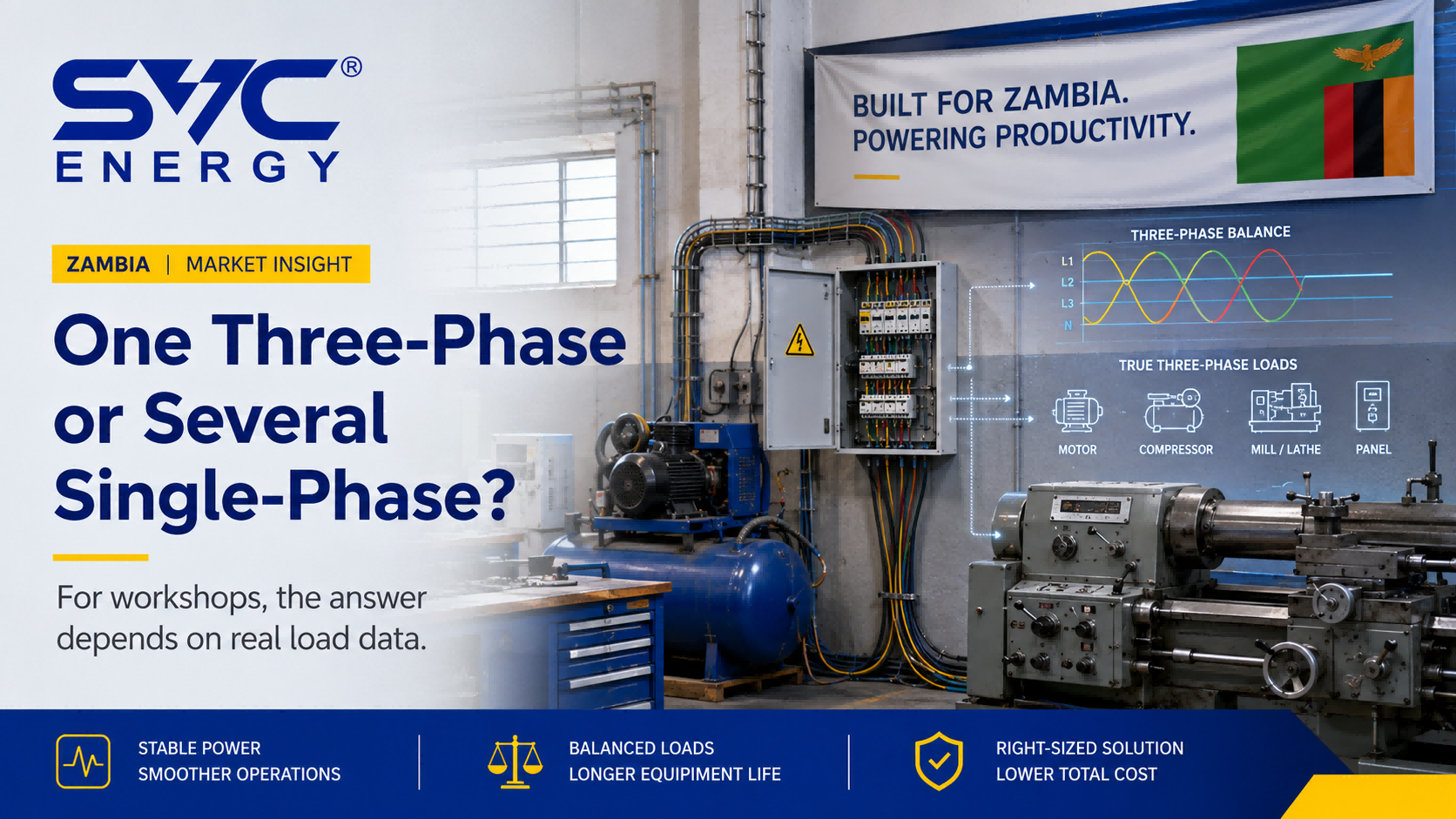
Should a Three-Phase Zambian Workshop Use One Three-Phase Hybrid Inverter or Several Single-Phase Inverters?
A workshop with genuine three-phase motors will usually be better served by one properly sized three-phase hybrid inverter. Several single-phase inverters make more sense when most loads are independent single-phase circuits and the equipment is approved for coordinated three-phase operation.
Quick Answer
Choose one true three-phase hybrid inverter when the workshop has essential three-phase motors, needs simpler phase balancing, or wants coordinated grid, generator and battery control. Consider several single-phase inverters only when most loads are independent single-phase circuits and the manufacturer explicitly supports synchronised three-phase operation.
Which Workshop Loads Really Require Three-Phase Power?
Start by separating the workshop equipment into three categories.
True Three-Phase Loads May Include
- Industrial air compressors
- Large water pumps
- Lathes and milling machines
- Three-phase welding equipment
- Hoists and lifts
- Extraction or ventilation motors
- Larger refrigeration compressors
- Other production machinery with three-phase motors
Single-Phase Loads May Include
- Lighting
- Computers and office equipment
- Small drills and grinders
- Security systems
- Routers and communication equipment
- Small refrigerators
- Single-phase sockets and hand tools
A true three-phase motor needs all three phases at the correct voltage, frequency and phase sequence. It cannot be reliably supported by three unrelated single-phase inverters. If several single-phase units are used, they must be approved by the manufacturer for synchronised three-phase operation.
Why Is One Three-Phase Hybrid Inverter Usually Simpler?
A true three-phase hybrid inverter creates and manages all three phases as one coordinated system.
Consistent Phase Sequence
Three-phase motors depend on the correct L1, L2 and L3 sequence. An incorrect sequence can cause a motor to rotate in the wrong direction, while a missing or unstable phase can interrupt production or damage equipment.
ZESCO’s renewable-energy technical specifications require the correct phase sequence for connected three-phase systems. If a workshop intends to operate in parallel with the grid or export electricity, its installer should verify the applicable ZESCO connection and protection requirements. Source reference: ZESCO renewable technical specifications.
Easier Phase Balancing
A workshop rarely places exactly the same load on every phase. One phase may serve office sockets and lighting, another may support hand tools, while a three-phase compressor draws from all three.
A three-phase hybrid inverter can monitor the complete system. This does not remove the need to distribute single-phase circuits carefully, but it reduces the complexity of coordinating several separate power sources.
Simpler Battery Management
One three-phase inverter normally uses one coordinated battery bank and one energy-management strategy. With several single-phase inverters, the designer must confirm:
- Whether they share one battery bank
- Whether separate batteries are required
- How charge and discharge currents are divided
- How the BMS communicates with every inverter
- Whether one inverter can overwork the shared battery
- What happens if communication with one unit fails
Improvised connections can result in unequal loading, conflicting settings or unexplained shutdowns.
Cleaner Grid and Generator Integration
Many Zambian workshops want to combine solar power with ZESCO supply, battery storage and a diesel generator. One three-phase hybrid inverter can simplify:
- Grid detection
- Generator input
- Battery charging
- Solar self-consumption
- Load priority
- Automatic transfer
- Export limitation
- Remote monitoring
Several independent single-phase inverters may require additional control equipment and careful interlocking to prevent conflicting power sources.
When Can Several Single-Phase Inverters Be Reasonable?
Several single-phase inverters can still be a valid design when the workshop mainly has independent single-phase loads. Separate units could serve office and communication circuits, lighting and security, small tools, selected socket circuits and non-critical support loads.
This approach may provide partial redundancy. If one inverter fails, circuits connected to the other units may continue operating. However, this does not guarantee that production continues. A three-phase motor cannot operate normally when one phase is unavailable.
Multiple single-phase inverters should only be considered when:
- The manufacturer explicitly supports three-phase parallel operation
- The units are compatible models with matching firmware
- Synchronisation accessories are included
- Battery communication is approved
- Phase-failure behaviour is documented
- Bypass and maintenance procedures are designed in advance
- A qualified installer commissions the complete system
Do Not Improvise a Three-Phase Supply
Three ordinary single-phase inverters should not simply be connected together to create an improvised three-phase supply.
How Should Motor Starting Power Affect the Decision?
Workshop systems are often undersized because buyers compare only the rated power of the motors. A motor can require considerably more power during startup than during normal operation.
Consider an illustrative workshop with:
- A 7.5 kW air compressor
- 5 kW of other loads operating at the same time
- A compressor startup demand assumed at three times rated power
Short-Duration Power Requirement
(7.5 kW × 3) + 5 kW = 27.5 kW
This does not mean the workshop necessarily needs a 27.5 kW continuous inverter. It means the installer must compare the measured or manufacturer-specified startup demand with the inverter’s overload duration and battery discharge capability.
A variable-frequency drive, soft starter or staged load sequence may reduce the peak. Compatibility with the motor and inverter must be confirmed by the equipment suppliers.
Welders also require special attention. Their demand can change rapidly and may introduce power-quality issues that are not visible from a simple average-kW calculation.
Is a 20 kW Inverter Enough for a 20 kW Workshop?
Not automatically. The workshop’s installed equipment might total 20 kW, but the correct inverter depends on:
- Maximum simultaneous load
- Largest motor starting current
- Welding load characteristics
- Phase imbalance
- Battery discharge-current limit
- Inverter overload curve
- Future machinery
- Generator support
- Required operating reserve
A workshop that normally averages 10 kW but occasionally starts a large compressor may need a different design from a facility that runs a stable 18 kW electronic load.
Ask for Two Calculations
The installer should provide both a continuous-load calculation and a motor-starting assessment.
How Does the Battery Affect Three-Phase Inverter Performance?
An inverter cannot deliver its rated power unless the battery bank can supply the required current.
For a simplified example, a 20 kW low-voltage inverter operating from a nominal 51.2 V battery system could require roughly:
Simplified DC Current Calculation
20,000 W ÷ 51.2 V = approximately 391 A
Actual DC current will be higher after accounting for inverter losses and operating voltage. The battery bank, BMS, busbars, cables, breakers and connections must all support the required current.
This is why battery capacity in kWh and battery output current in amps must be checked separately. A battery may contain enough energy for the desired runtime but still be unable to provide the instantaneous current required by heavy workshop machinery.
Where Does an SVC Three-Phase System Fit?
SVC offers low-voltage three-phase hybrid inverters from 5 kW to 20 kW for residential and small commercial applications.
Documented Three-Phase Range Features
- Direct three-phase output
- Grid and diesel-generator access
- Lead-acid or lithium batteries
- BMS-adaptive lithium charging
- Two MPPT inputs
- App and web monitoring
- Automatic switching in less than 10 ms
- A 40 V–60 V battery range
- IP66 protection
- Up to 400 A charge and discharge current on the 20 kW model
The 20 kW model may be relevant to a workshop with pumps, compressors or other three-phase machinery, but suitability cannot be confirmed from the inverter’s rated power alone. The motor startup data, overload curve, load profile and battery design must also be checked.
Battery Pairing Example
For longer backup, the system can be paired with modular lithium storage. SVC’s 16.08 kWh battery uses a 51.2 V / 314 Ah configuration and supports up to 200 A continuous discharge under the specified temperature conditions.
More than one battery may therefore be required when the workshop needs both high output current and longer runtime. The exact number must be calculated from inverter demand, desired autonomy, battery operating limits and the approved parallel configuration.
What Are the Disadvantages of Several Single-Phase Inverters?
Although modularity can appear cheaper or easier to expand, several units may add:
- More AC and DC protection devices
- Additional communication cables
- More complex commissioning
- More wall or equipment-room space
- More possible points of failure
- Difficult fault diagnosis
- Phase-balancing work
- Extra bypass and isolation equipment
- Multiple firmware and configuration records
- Higher installation labour
The purchase price of the inverters should therefore not be compared on its own. Compare the complete installed system.
When Is Redundancy More Important Than Simplicity?
A workshop with high downtime costs may want redundancy even when it chooses a three-phase inverter. Possible strategies include:
- A generator sized for critical machinery
- A maintenance bypass
- Separate backup for office and communication loads
- Load shedding that disconnects non-critical machinery
- A parallel-ready three-phase system
- Spare critical components
- A service agreement with defined response times
Several single-phase inverters are only one form of redundancy, and they may not protect a true three-phase production load.
What Should the Installer Measure Before Recommending a Design?
Request a site survey covering:
- Utility supply type and voltage
- Phase sequence
- Maximum demand on each phase
- Largest motor and startup current
- Welder specifications
- Compressor and pump duty cycles
- Simultaneous production loads
- Existing generator rating
- Daily and hourly energy use
- Required backup duration
- Roof or ground-mounted PV capacity
- Planned future machinery
- Earthing and surge protection
- Grid-export or zero-export requirement
The final proposal should include a single-line diagram, load schedule, protection design, battery-current calculation and operating sequence for solar, battery, grid and generator power.
Who Should Install the System in Zambia?
The Energy Regulation Board states that businesses involved in the manufacture, supply, installation and maintenance of renewable-energy equipment must be licensed under Zambia’s energy-sector framework. Buyers can check the ERB licence register.
ZESCO’s power-connection process also refers to certification of the electrician responsible for wiring. A grid-connected workshop should confirm all current ERB, ZESCO and Engineering Institution of Zambia requirements before installation or commissioning.
Use the Load Study to Choose the Architecture
Choose one true three-phase hybrid inverter when the workshop has essential three-phase motors, wants simpler battery and generator control, or needs a clearly coordinated power system.
Consider several single-phase inverters only when most loads are independent single-phase circuits, partial redundancy has real value and the equipment manufacturer explicitly supports synchronised three-phase operation.
In both cases, the deciding evidence should be a measured phase-by-phase load profile and motor-starting study—not the cheapest equipment quotation.
Frequently Asked Questions
Can Three Normal Single-Phase Inverters Create Three-Phase Power?
Only if the manufacturer specifically supports synchronised three-phase operation and provides the required communication and configuration method.
Will Several Inverters Keep a Three-Phase Motor Running if One Fails?
Normally no. A true three-phase motor requires all three phases, so the protection system may shut the motor or the entire inverter group down.
Does a 20 kW Inverter Require a 20 kWh Battery?
Not necessarily. Inverter kW determines power, while battery kWh determines stored energy. Battery output current and desired runtime must both be calculated.
Can a Three-Phase Inverter Also Power Single-Phase Workshop Loads?
Often yes, provided those loads are distributed within the inverter’s phase limits and the complete system is correctly designed.
Should the Generator Match the Inverter’s Full Rating?
Not automatically. Generator sizing depends on the supported loads, battery-charging current, motor starting and the inverter’s generator-input requirements.
Planning a Three-Phase Workshop Solar-and-Storage System?
Start with a phase-by-phase load profile, motor-starting data, battery-current calculation and a clear operating plan for solar, battery, ZESCO supply and generator power.
Contact SVC EnergyCan a Hybrid Inverter Safely Combine Kenya Power, Rooftop Solar and a Generator?
What Extra Charges Should You Check Before Signing Up for Battery Rental or Energy-as-a-Service in Nigeria?
Related Article