What Extra Charges Should You Check Before Signing Up for Battery Rental or Energy-as-a-Service in Nigeria?
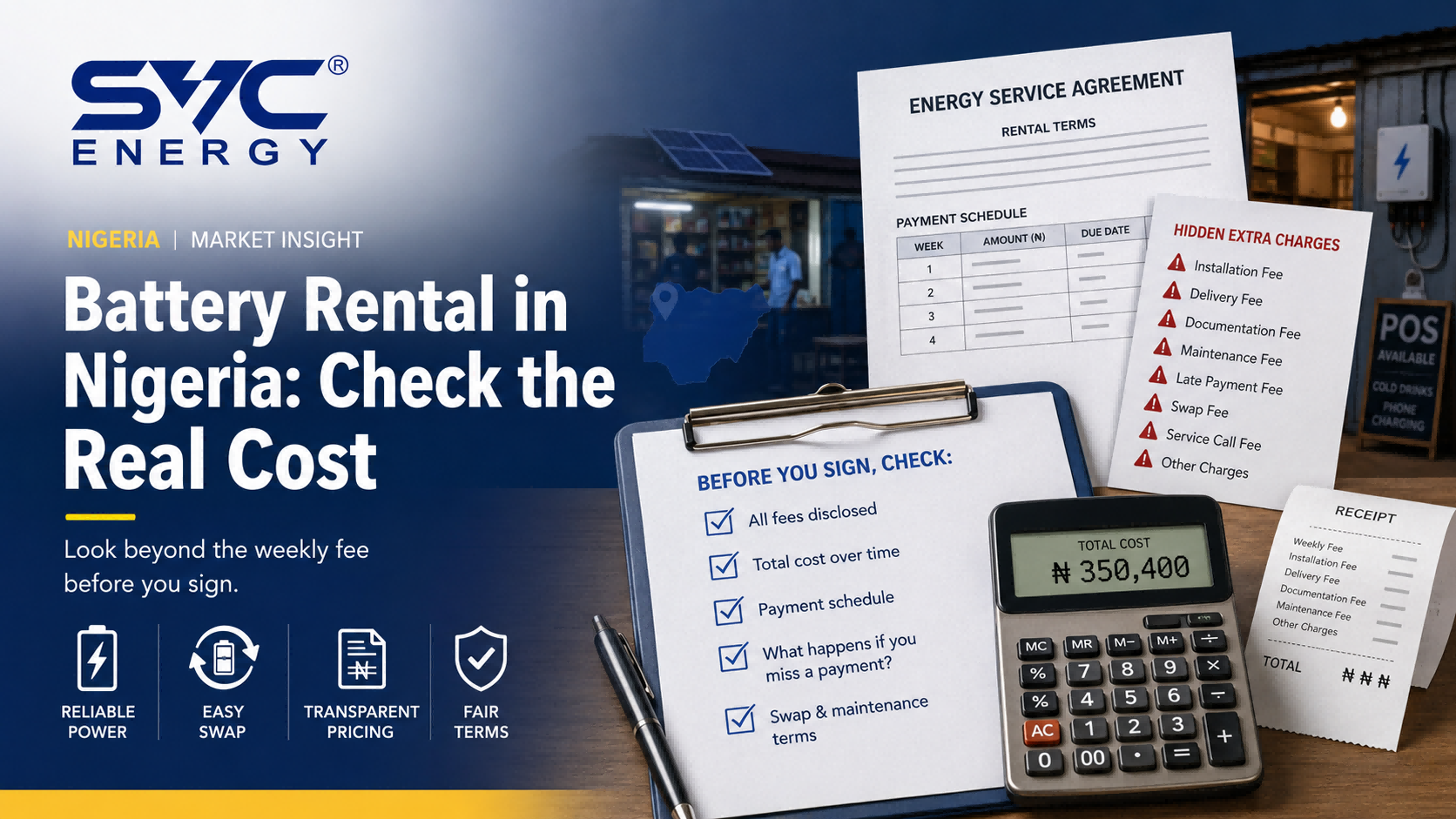
What Extra Charges Should You Check Before Signing Up for Battery Rental or Energy-as-a-Service in Nigeria?
Before signing a battery rental or energy-as-a-service contract, check more than the advertised daily, weekly or monthly payment. The lowest regular payment may not produce the lowest total cost.
Quick Answer
Ask for a written fee schedule covering the deposit, activation, installation, swaps, delivery, monitoring, maintenance, damage, late payment, reconnection, cancellation, upgrades and ownership. Then calculate the full first-year and long-term cost using the actual contract charges.
Why the Contract Matters More Than the Advertised Payment
Battery rental is becoming more relevant in Nigeria. A recently announced partnership between the Rural Electrification Agency and MOPO plans to expand a smart battery rental programme that gives users access to portable energy without requiring them to buy the equipment upfront. MOPO describes the model as pay-per-use battery access through community solar hubs.
However, individual providers may use very different pricing and service terms. Buyers should assess the actual contract rather than assume every rental plan works the same way.
Is the Deposit Refundable?
A provider may require a security deposit before releasing the battery or installing equipment.
- Is the deposit fully refundable?
- When will it be returned?
- Can the provider deduct repair, cleaning or transport costs?
- What condition must the battery be in?
- Is there an inspection fee when the service ends?
- What happens if the provider disputes the battery’s condition?
A refundable deposit is not necessarily a service cost, but it affects the amount of cash required at the beginning. If deductions are possible, the contract should explain how they will be calculated.
Are Activation and Installation Included?
The advertised rental rate may exclude the initial setup. Possible additional charges include:
- Customer registration
- Account activation
- Site inspection
- Load assessment
- Delivery
- Wall mounting or equipment positioning
- Battery cables and connectors
- Changeover equipment
- Breakers, fuses and protection devices
- Inverter configuration
- Mobile app or monitoring setup
- User training
For a portable battery, installation may be minimal. A fixed home or small-business energy service could require considerable wiring and protection work.
Ask for a Written Definition of “Installation Included”
It should state exactly which cables, breakers, labour and accessories are covered.
Does the Regular Payment Include the Energy You Use?
A battery rental charge and an energy charge are not always the same thing. The provider may charge for:
- Access to the battery
- Each battery exchange
- Each recharge
- Energy consumed in kWh
- A fixed number of swaps
- Usage above an included allowance
- Peak-period or urgent service
Ask whether the regular payment provides unlimited use, one battery cycle, a specified amount of energy or only possession of the equipment.
If the plan includes an energy allowance, find out what happens to unused energy and how additional consumption is priced.
Who Pays for Battery Delivery and Swapping?
A portable battery service may require customers to collect batteries from a hub. Home delivery may carry a separate charge.
- Price per delivery or collection
- Distance or service-zone charges
- Urgent-delivery fees
- Minimum number of batteries per delivery
- Weekend or evening service charges
- Failed-delivery charges
- Whether the price can change with transport costs
A service that appears affordable near a battery hub may become considerably more expensive if the customer repeatedly pays for delivery.
Ask About Battery Availability
The contract should explain whether the customer receives a credit, refund or service extension when a charged replacement battery is unavailable.
Are Monitoring and Payment Charges Separate?
Smart batteries may use remote monitoring, mobile data or a digital account. Possible charges include:
- App subscription
- SIM or connectivity fee
- Account-management fee
- Mobile-money transaction charge
- Payment-processing fee
- Printed statement fee
- Remote technical-support subscription
The provider should also explain which data it collects, how long it is stored and whether the battery can be remotely disabled.
What Maintenance Is Actually Included?
“Maintenance included” can mean different things. Ask whether the service covers:
- Routine inspections
- Battery-health checks
- Software or firmware updates
- Fault diagnosis
- Technician travel
- Labour
- Replacement parts
- Temporary replacement equipment
- Battery replacement following normal failure
The contract should distinguish normal equipment failure from damage attributed to overloading, incorrect use, poor ventilation, water, fire, theft, unauthorised repairs or incompatible appliances.
A free replacement battery may still result in inspection, transport or technician charges unless the contract says otherwise.
What Happens After a Missed Payment?
Battery rental services may depend on regular digital payments, and some equipment may support remote disabling. Before signing, ask about:
- Payment grace period
- Late-payment fee
- Interest on overdue balances
- Remote shutdown
- Reconnection or reactivation charge
- Battery collection
- Contract termination
- Recovery of outstanding payments
- Effect on the security deposit
The household or business should understand how quickly service can stop after a missed payment—especially if the battery supports refrigeration, internet access, security equipment or business transactions.
Where a plan also includes consumer credit, the provider should clearly disclose applicable fees, default charges and contract conditions. Source reference: FCCPC consumer-lending information.
Will You Ever Own the Equipment?
Battery rental, lease-to-own and energy-as-a-service are not interchangeable. Under a pure rental plan, the provider normally retains ownership. Under lease-to-own, ownership may transfer after the final payment. With energy-as-a-service, the customer may be buying electricity availability rather than the battery itself.
- Does ownership transfer?
- After how many payments?
- Is there a final buyout charge?
- Must the customer request ownership transfer?
- Who owns the inverter, panels and cables?
- What happens to the equipment when the contract ends?
- Can the customer buy the battery early?
- Does early payment reduce the remaining charge?
Do Not Assume Ownership
Making payments for several years does not automatically create ownership rights unless the contract states this clearly.
Are Upgrades and Cancellations Chargeable?
A household or shop may later need a larger battery or higher-power inverter. Check for:
- Upgrade assessment fees
- Equipment exchange charges
- New deposit requirements
- Contract restart or extension
- Downgrade fees
- Early-cancellation penalties
- Equipment-removal charges
- Final inspection fees
- Notice-period requirements
Also ask whether the customer can keep using the service if they move to another house, shop or city.
How Should You Calculate the Real First-Year Cost?
First-Year Cost Formula
First-year cost = activation + installation + regular payments + delivery or swap charges + connectivity + insurance or damage cover + expected service charges
Assume a hypothetical plan includes:
- ₦100,000 activation and installation
- ₦12,000 weekly service payment
- ₦2,000 monthly connectivity charge
- ₦3,000 monthly delivery charge
- ₦80,000 annual damage cover
Worked Example
₦100,000 + (₦12,000 × 52) + (₦2,000 × 12) + (₦3,000 × 12) + ₦80,000
Estimated first-year service cost: ₦864,000
If the provider also requires a refundable ₦50,000 deposit, the initial first-year cash outlay becomes ₦914,000, although the deposit may eventually be returned.
This is a calculation example, not a current provider quotation. Replace every figure with the written charges supplied by the actual service company.
How Should You Compare Rental With Owning a Battery?
Compare both options over the same period and for the same usable energy, inverter power and service level.
Rental can reduce the initial financial burden and may transfer maintenance responsibility to the service provider. Ownership can require more cash upfront but may avoid repeated rental charges and give the customer greater control over the system.
A Measurable Ownership Baseline
The SVC Phoenix battery uses a documented 51.2 V / 205 Ah configuration, providing approximately 10.5 kWh of nominal energy. Its supplied product materials specify LiFePO4 chemistry, smart BMS monitoring, more than 6,000 cycles and a five-year warranty for the applicable standalone battery family.
These specifications do not determine whether renting or buying is cheaper by themselves. They provide a clear equipment baseline against which a rental provider’s capacity, warranty and service promise can be compared.
What Should Be Written in the Contract?
Before paying, request a document showing:
- Complete fee schedule
- Deposit and refund rules
- Included energy or battery swaps
- Delivery coverage
- Maintenance responsibilities
- Damage and theft conditions
- Payment grace period
- Shutdown and reconnection rules
- Price-review method
- Service-availability commitment
- Cancellation charges
- Ownership or buyout conditions
- Complaint and escalation process
Avoid relying only on an advert, WhatsApp message or verbal promise. Keep the signed contract, receipts, equipment serial numbers and screenshots of the original offer.
If a provider does not resolve a documented consumer complaint, the FCCPC operates an online complaint-handling system. Source reference: FCCPC complaint procedure.
Compare the Full Contract Cost, Not Only the Regular Payment
The right battery rental or energy-as-a-service plan is the one with transparent fees, clear ownership rules, dependable maintenance, reasonable delivery terms and a realistic first-year and long-term cost—not simply the lowest advertised weekly or monthly payment.
Frequently Asked Questions
Is Battery Rental Always Cheaper Than Buying?
No. It usually reduces the upfront payment, but repeated service, swap, delivery and account charges can raise the total long-term cost.
Is a Security Deposit Part of the Service Price?
A genuinely refundable deposit is different from a fee, but it still affects the customer’s cash requirement and may be reduced by contract deductions.
Can a Rented Smart Battery Be Switched Off Remotely?
Some connected service models may support remote control or disabling. The provider should disclose when this can happen and what payment notice is given.
What Is the Biggest Contract Warning Sign?
A low advertised payment accompanied by no complete fee schedule, unclear maintenance exclusions or no written explanation of ownership and cancellation.
Should a Small Shop Ask for an Uptime Guarantee?
Yes, if the battery supports revenue-critical loads. The agreement should explain service response, replacement availability and what happens when a charged battery cannot be supplied.
Need Help Comparing a Battery Rental Offer?
Ask for the complete fee schedule, included energy or swaps, delivery terms, maintenance exclusions, ownership conditions and total first-year cost before signing.
Contact SVC EnergyShould a Three-Phase Zambian Workshop Use One Three-Phase Hybrid Inverter or Several Single-Phase Inverters?
Can a Kenyan EV Owner Use Rooftop Solar and a Home Battery Without Oversizing the System?
Related Article