Can a Hybrid Inverter Safely Combine Kenya Power, Rooftop Solar and a Generator?
How Should Kenya Power, Rooftop Solar, Battery Storage and a Generator Be Connected to a Hybrid Inverter?
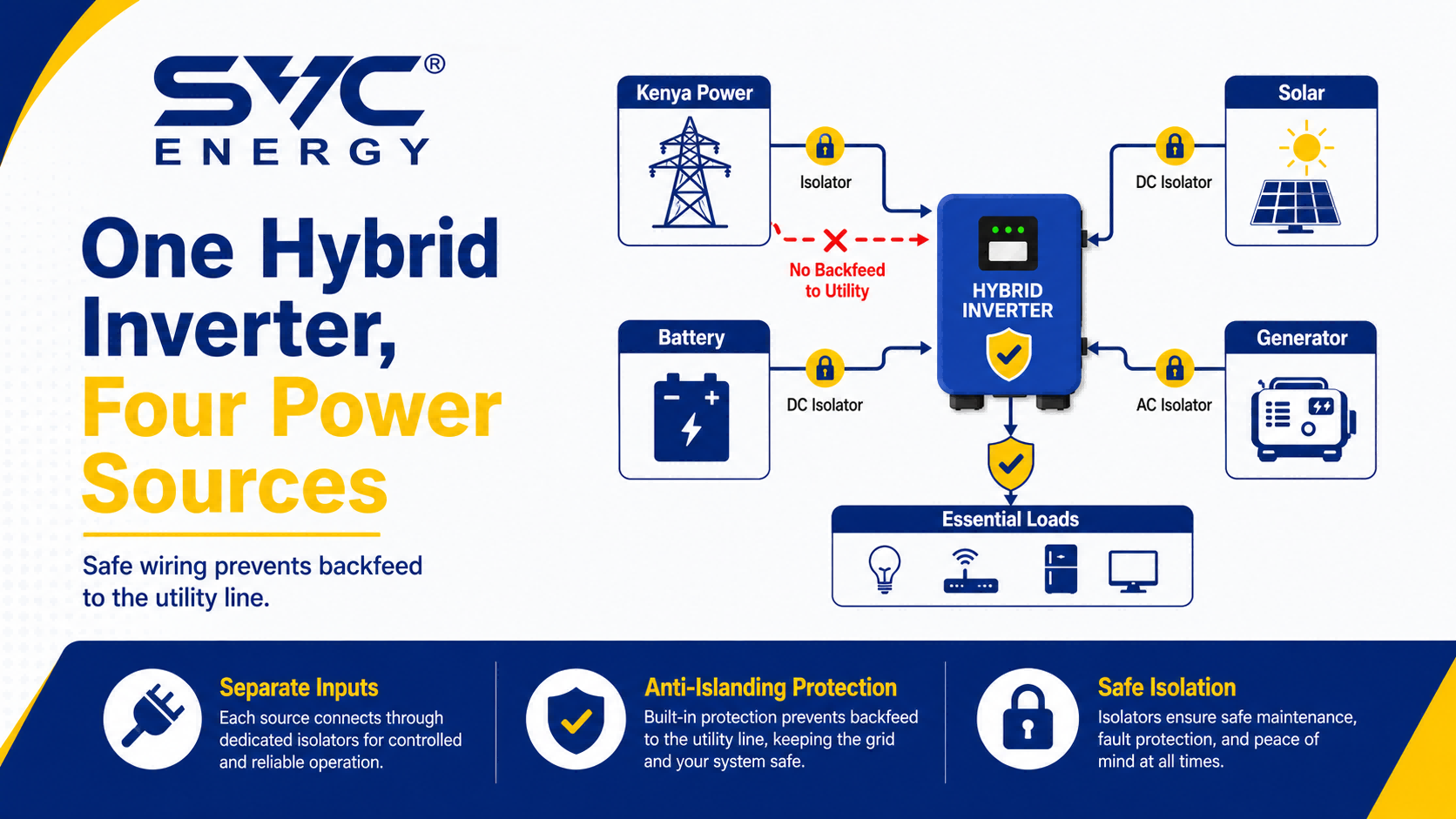
A hybrid inverter can safely manage Kenya Power, rooftop solar, battery storage and a generator, but the sources must not simply be joined on one cable or distribution bus. Each source needs a controlled input, correct isolation and protection against backfeed.
Quick Answer
Solar should enter through the inverter’s PV inputs, Kenya Power through the grid input, and the generator through a dedicated generator port or an approved interlocked changeover arrangement. Essential loads should remain on an isolated backup output, and the design must prevent the inverter or generator from energising the Kenya Power line during an outage.
How Should the Three Power Sources Be Connected?
A properly designed system keeps each source electrically controlled:
- Rooftop solar connects to the inverter’s DC MPPT inputs through the required DC protection.
- Kenya Power connects to the inverter’s grid input through AC protection and an accessible isolator.
- The generator connects to a dedicated generator input where the inverter supports one, or through an approved automatic transfer arrangement.
- Essential loads connect to the inverter’s backup or EPS output.
- Non-essential loads may remain on the main distribution board, depending on the design.
Do Not Parallel the Generator With Kenya Power
The generator should never be connected directly in parallel with Kenya Power unless the equipment was specifically designed, protected and approved for synchronised parallel operation. A normal standby generator installation should use mechanical or electrical interlocking so that the generator and utility cannot energise the same incoming circuit simultaneously.
Do Not Loop the Backup Output Into the Grid Input
The inverter’s backup output must not be looped back into its grid input or the main utility bus. That mistake can create circulating power, damaged equipment or dangerous backfeed.
What Stops Solar or Battery Power From Reaching a Dead Kenya Power Line?
This is the job of anti-islanding protection and the system’s isolation devices.
When Kenya Power fails, a compliant grid-connected inverter must disconnect its grid-facing side. It may continue powering an isolated essential-load circuit from solar and the battery, but it must not energise the public distribution line.
Kenya’s 2024 Net-Metering Regulations require authorised installation and a safe, single point of interconnection. They also require protection against backfeeding a de-energised line, including a clearly labelled manual disconnect unless the specified automatic-disconnection conditions are satisfied. The net-metering agreement further provides for automatic inverter isolation and accessible external isolation. Source reference: Kenya Law, Energy (Net-Metering) Regulations, 2024.
Zero Export Is Not a Substitute for Protection
This protection matters even when the owner does not intend to export electricity. Selecting “zero export” in an app is not a substitute for correct wiring, anti-islanding protection and commissioning.
How Does Zero-Export Control Work?
A zero-export system normally uses a current transformer, smart meter or external energy meter at the site’s point of connection. The inverter reads the direction and amount of power flowing between the premises and Kenya Power, then reduces its output when surplus energy would otherwise leave the site.
Common commissioning errors include:
- Installing the CT in the wrong direction
- Placing the CT around the wrong conductor
- Configuring the wrong meter type or communication address
- Measuring only one phase of a three-phase installation
- Setting an export limit without testing it under changing loads
- Losing communication between the meter and inverter without a safe fallback response
A reversed CT can make the inverter interpret export as import. The display may appear normal while the controller responds in the wrong direction. The installer should therefore test the system with real load changes rather than relying only on the monitoring screen.
If the owner wants to export surplus solar under net metering, the system requires the relevant application, agreement, metering and interconnection arrangements. Kenya’s regulations distinguish controlled grid export from ordinary self-consumption and place the connection point and metering requirements under the licensee’s approval.
What Should Happen When Kenya Power Fails?
A correctly commissioned sequence should look like this:
- The inverter detects loss of Kenya Power.
- Its grid-side relay opens to prevent backfeed.
- Essential loads continue on the isolated backup circuit, subject to inverter and battery capacity.
- The generator starts manually or through an approved automatic-start signal.
- After its voltage and frequency stabilise, the inverter accepts generator power through the designated input.
- The generator may supply loads and charge the battery within configured current limits.
- When Kenya Power returns and remains stable for the programmed delay, the system transfers back without connecting the generator to the utility.
Generator Acceptance Requires More Than Approximate Voltage
The generator should not be accepted merely because it produces approximately 230 V or 400 V. The inverter must confirm that voltage, frequency and waveform are within its permitted generator-input range.
Neutral Switching and Earthing Need Site-Specific Design
Generator neutral bonding, inverter backup operation and residual-current protection can interact differently from site to site. These decisions should be made by an authorised technician using the inverter manual and the applicable Kenyan requirements—not copied from a generic online wiring diagram.
What Should the Installer Demonstrate Before Handover?
Ask for a witnessed commissioning test covering:
- Kenya Power operation with solar production
- Zero-export response when site loads suddenly fall
- Grid-failure isolation and continued operation of essential loads
- Confirmation that the utility-side conductors remain de-energised during backup operation
- Generator start, warm-up, acceptance and shutdown
- Rejection of generator power when its voltage or frequency is outside limits
- Transfer back to Kenya Power without generator-to-grid overlap
- Correct CT orientation on every applicable phase
- Operation of AC and DC isolators, breakers and surge protection
- Earthing, neutral arrangement and residual-current protection tests
- Alarm history and monitoring data after each transition
For a net-metered installation, the regulations provide for testing and commissioning by an authorised person and allow the licensee to witness commissioning following written notice. They also require approval before later replacement or modification of the net-metering system or connection point.
Which SVC Hybrid Inverter Architecture Fits This Requirement?
Single-Phase Homes and Small Businesses
For a single-phase Kenyan home or small business, the SVC HI-8K-SL2 and HI-10K-SL2 are relevant candidates because the current SVC catalog identifies generator-input and zero-export functions. The models provide 8 kW or 10 kW output, use a 40–60 V battery system and specify backup switching below 10 ms.
Three-Phase Workshops and Commercial Properties
For a three-phase workshop, hotel, farm or commercial property, the SVC HI-5K-TL to HI-20K-TL family is the more natural architecture. The catalog states that this family supports both grid and generator access, several operating modes, remote monitoring and backup switching at or below 10 ms.
These product features can simplify source management, but they do not replace the site design. Before installation, the supplier and authorised technician should confirm:
- The exact inverter model and firmware
- Single-phase or three-phase service
- Dedicated generator-port behaviour
- Generator start and stop interface
- Required CT or energy-meter model
- Export-control settings
- Neutral and earthing arrangement
- Local interconnection and model-level compliance documents
The Safest Buying Question
Do not ask only, “Does this inverter accept solar, grid and generator?” Ask, “Can the installer show the approved single-line diagram and demonstrate every source transition without backfeed?”
Keep Every Source Controlled and Prevent Backfeed
A safe Kenyan hybrid system keeps rooftop solar, Kenya Power, the battery and the generator on their intended inputs, isolates essential loads during an outage and uses anti-islanding, interlocking and tested zero-export control. The final proof is not the monitoring screen—it is a witnessed commissioning test showing that no source can energise the Kenya Power line or overlap with another source incorrectly.
Frequently Asked Questions
Can I Connect the Generator to the Inverter’s Grid Input?
Only if the exact inverter manual permits that configuration and an approved changeover arrangement ensures that Kenya Power and the generator cannot overlap. A dedicated generator port is generally clearer because it allows generator-specific limits and control logic.
Does Zero Export Mean I Do Not Need Anti-Islanding Protection?
No. Zero export controls normal power flow; anti-islanding protects the public line when utility power disappears. The system still needs correct isolation and protective equipment.
Planning a Hybrid Solar, Battery and Generator System in Kenya?
Ask for an approved single-line diagram, confirmed generator and CT configuration, anti-islanding protection and a witnessed commissioning sequence before handover.
Contact SVC Energy
Should a Three-Phase Zambian Workshop Use One Three-Phase Hybrid Inverter or Several Single-Phase Inverters?
Related Article