How Can I Avoid Buying a Cheap Inverter or Battery That Fails After One Year in Kenya?

How Can You Avoid Buying a Solar Inverter or Battery That Fails Early in Kenya?
The safest way to avoid a solar inverter or battery that fails early is not simply to buy the most expensive option. It is to verify what you are actually getting: real battery capacity, suitable inverter sizing, clear protection settings, a competent installer and written after-sales support. In Kenya, a low initial quotation can become costly if it leaves out proper wiring, commissioning, battery protection or support after installation.
Quick Answer
The best way to avoid an inverter or battery that fails early is to verify the specifications, match the system to the real appliance load, insist on proper commissioning and confirm who will provide local after-sales support before you pay.
Do Not Compare Quotations by Price Alone
Two solar quotations can look similar while including very different systems. One may include a lithium battery, a correctly sized hybrid inverter, circuit protection, installation, commissioning and a clear warranty process. Another may list only panels, an inverter and a battery, leaving important materials or labour outside the price.
Before comparing offers, ask each seller to provide a written breakdown of:
- ✓Inverter make, model and rated output power
- ✓Battery chemistry, nominal voltage and nominal energy in kWh
- ✓Solar-panel quantity and wattage
- ✓Protection devices, cables, mounting and installation scope
- ✓Which appliances the system is designed to support
- ✓Whether the system includes solar charging, grid charging or both
- ✓Commissioning, training and after-sales support
- ✓Warranty term, exclusions and who will handle a fault locally
Check the Battery’s Real Capacity and Protection
Battery capacity should be stated in kWh, not only in amp-hours. To understand the nominal energy, you need both voltage and amp-hours. For example, a battery rated at 51.2 V and 205 Ah has nominal energy of about 10.5 kWh. This does not mean every kWh is available for every appliance under every condition; actual usable energy depends on battery settings, inverter efficiency, temperature and load behaviour.
Questions to Ask the Seller
- ✓Is the battery LiFePO4, lead-acid, gel or another chemistry?
- ✓What are its nominal voltage, amp-hours and kWh?
- ✓Does it have a battery management system (BMS)?
- ✓Is the BMS communication compatible with the selected inverter?
- ✓What are the recommended charge and discharge limits?
- ✓Can you see the battery status through a display or monitoring app?
- ✓What documents prove the product model and warranty?
51.2 V × 205 Ah
Nominal energy helps buyers compare batteries on a like-for-like basis.
Match the Inverter to the Actual Appliances
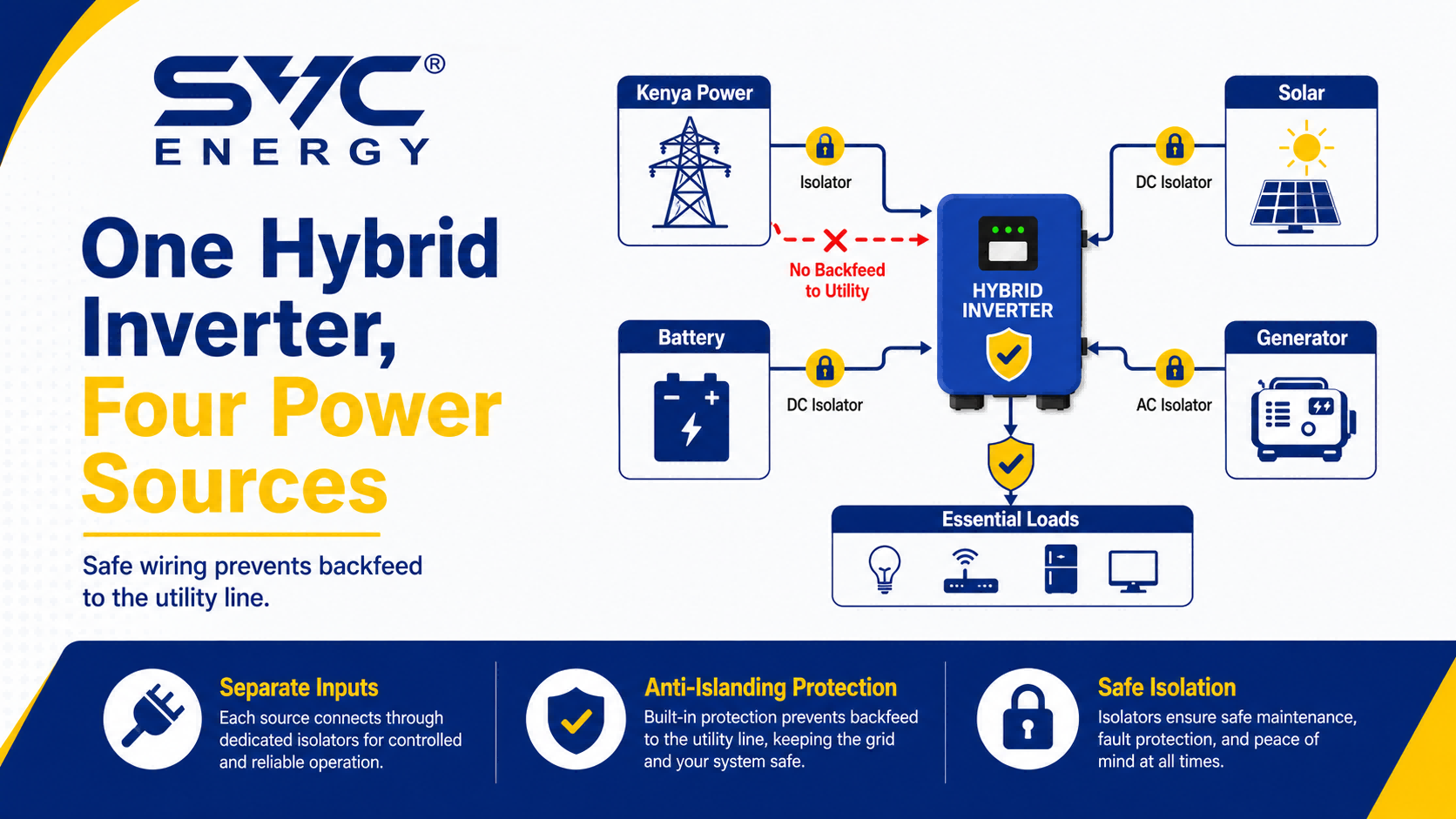
An inverter can fail early when it is repeatedly overloaded or used with appliances it was never designed to support. A 5 kW inverter is not automatically suitable for every home simply because the total appliance labels add up to less than 5 kW. Refrigerators, pumps, compressors and some power tools can draw a much higher starting current than their normal running power.
Make a list of the appliances you want to run during an outage. Separate critical loads, such as lights, Wi-Fi, a TV, phone charging and a fridge, from high-demand loads such as kettles, irons, water heaters, pumps and air conditioners.
Critical Appliances
- ✓Lights
- ✓Wi-Fi router
- ✓TV
- ✓Phone charging
- ✓Refrigerator
High-Demand Loads
- —Kettles
- —Electric irons
- —Water heaters
- —Pumps
- —Air conditioners
The installer should explain:
- ✓Which loads can run together
- ✓Which loads should stay off during backup operation
- ✓Whether motor-starting surge has been considered
- ✓Whether essential loads are separated from non-essential circuits
- ✓How solar, grid and battery charging priorities are configured
Treat the Installer as Part of the Product
A reliable battery and inverter can still perform poorly if the installation is rushed or incomplete. Before payment, confirm who is responsible for site assessment, installation, commissioning and support.
A qualified installer should inspect the roof or panel location, identify shading risks, assess the electrical distribution board, size cables and protection devices, configure the inverter and test the system under normal loads.
Ask the Installer to Demonstrate
- ✓How the system switches during a grid outage
- ✓How to read battery state of charge and inverter alarms
- ✓Which circuit is the essential-load circuit
- ✓How the system recharges from solar and grid
- ✓What to do when the battery reaches a low state of charge
- ✓How to shut down the system safely in an emergency
- ✓Who to contact if there is an alarm or loss of backup power
Watch for These Red Flags Before You Buy
- —No clear product model number
- —No battery capacity calculation
- —No written warranty terms
- —Guaranteed all-night runtime without an appliance list
- —No explanation of battery chemistry
- —Vague answers about local support
- —Reused or unlabelled electrical equipment
- —Pressure to pay before a site assessment
Avoid changing inverter settings, opening battery cases or repairing electrical connections yourself. If a system develops repeated alarms, unusual heat, damaged cables, swelling or a burning smell, switch off the system safely if instructed by the installer and request qualified service.
Best Value Means a System You Can Verify
The best-value solar backup system in Kenya is not necessarily the cheapest or the largest. It is the one that clearly matches your appliance list, uses documented components, is installed and commissioned properly, and comes with support you can use after installation. Ask for specifications, a load plan, a commissioning test and written warranty responsibility before you pay.
Comparing Solar Quotations in Kenya?
Compare documented capacity, load suitability, installation scope, commissioning and local support—not only the headline price.
Contact SVC EnergyWhich Inverter Alarms Should I Understand Before Calling a Solar Technician in Nigeria?
Why Does My Solar System Still Fail After Installation in Zambia?
Related Article