For a Kenyan Milk Bar or M-Pesa Shop, Is Battery Backup Cheaper Than Losing Sales During Outages?
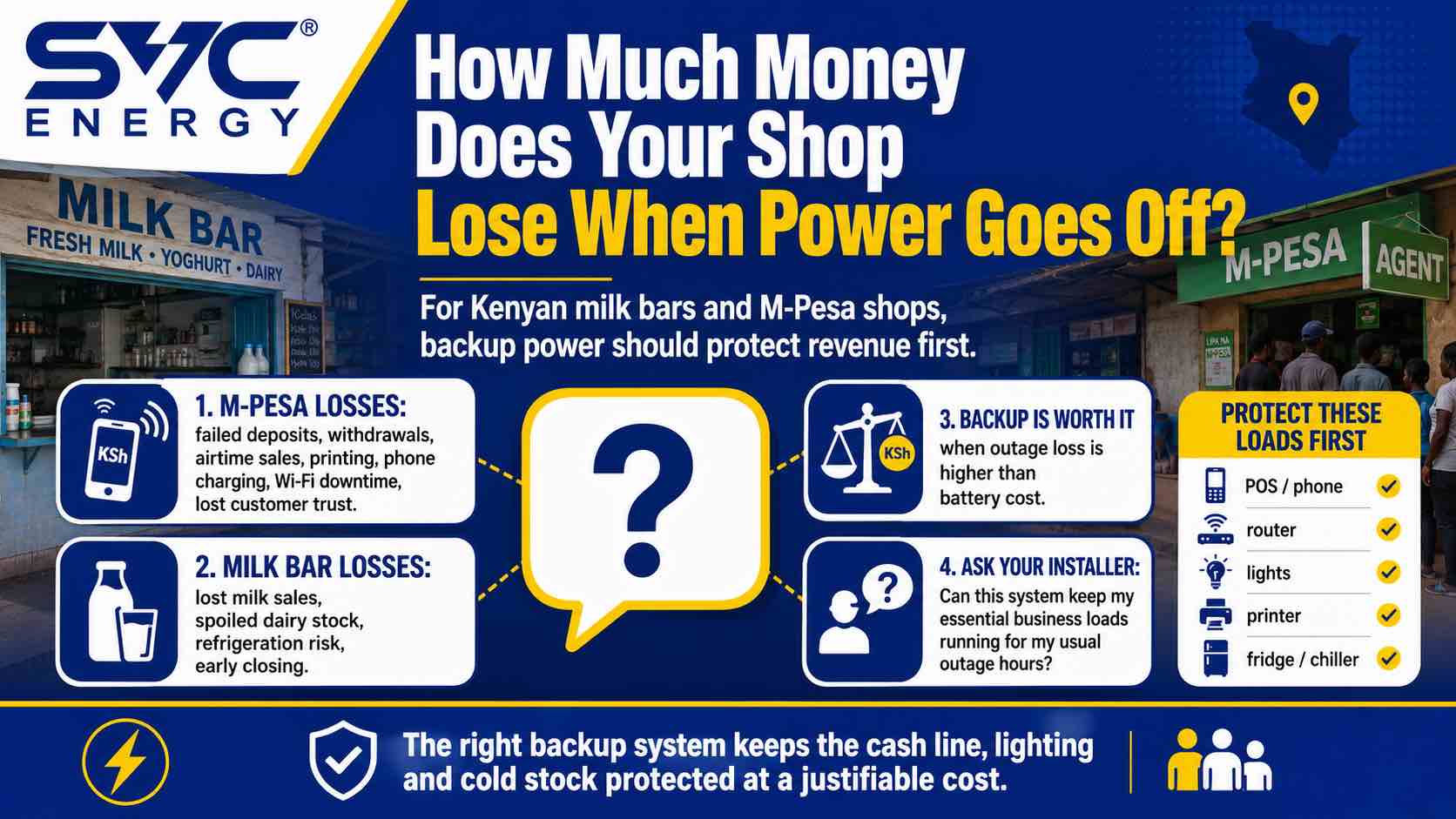
For a Kenyan milk bar or M-Pesa shop, battery backup is cheaper than losing sales only when the cost of downtime is higher than the daily or monthly cost of keeping essential equipment running.
The calculation should not start with battery size. It should start with one business question:
How much money does the shop lose when power goes off during trading hours?
For an M-Pesa shop, the loss may come from failed deposits, withdrawals, airtime sales, phone charging, printing, lighting, Wi-Fi or customer trust. For a milk bar, the loss is usually bigger because power cuts can affect sales and refrigeration at the same time. If milk, yoghurt or cold drinks warm up for too long, the owner may lose stock, not just one or two hours of revenue.
Kenya Power’s own site shows that commercial and SME customers are a defined customer group, and it also publishes power maintenance schedules and outage reporting channels. That means small businesses should treat electricity reliability as an operating risk, not only as a home comfort issue. Kenya has also seen wider discussion about power capacity pressure, including recent reporting on large data-centre demand and national grid limitations. For small merchants, the lesson is simple: backup power should be sized around the loads that protect revenue first.
A simple formula for a Kenyan shop owner
Use this basic comparison:
Monthly outage loss = average outage hours per month × profit or sales lost per outage hour + spoiled stock risk + generator fuel or emergency costs
Monthly battery cost = battery system price ÷ expected useful months + charging cost + basic maintenance or financing cost
If monthly outage loss is higher than monthly battery cost, battery backup may make commercial sense.
If outage loss is lower, the owner may still buy backup for customer service, safety or stock protection, but the decision is no longer purely about payback.
Example 1: M-Pesa shop
An M-Pesa shop does not usually need a large solar battery system if the goal is only to keep transactions moving.
Essential loads may include:
Phone or POS device
Router or internet device
Small printer
LED lights
One or two phone charging points
Maybe a laptop or small desktop
If these loads average about 150W to 300W and the owner wants 6 hours of backup, the usable energy need is roughly:
0.15kW to 0.3kW × 6 hours = 0.9kWh to 1.8kWh usable energy
After allowing for inverter losses, battery reserve and real operating conditions, a practical installed battery size may be around 2kWh to 4kWh.
For this type of shop, an entry-level all-in-one or solar generator style system can be enough if it is not expected to run a fridge, kettle, microwave or heavy appliance. SVC’s 1.2kW + 4kWh solar generator can fit this kind of light commercial backup use, especially for lighting, phone charging, router and transaction devices.
Example 2: Milk bar
A milk bar has a different problem. The most important load is not just a payment device. It is refrigeration.
Essential loads may include:
Milk fridge or chiller
Small freezer or cold display
Lights
M-Pesa/POS device
Router
Small fan
Occasional phone charging
A fridge or chiller also has compressor surge. That means the inverter must be sized for starting current, not only the running watts printed on the appliance label.
If the milk bar’s essential loads average 700W to 1.2kW during outage hours and the owner wants 6 hours of backup:
0.7kW to 1.2kW × 6 hours = 4.2kWh to 7.2kWh usable energy
After reserve and inverter losses, the installed battery may need to be around 6kWh to 10kWh. If the shop has multiple fridges, longer outages or wants to protect stock overnight, 10kWh to 16kWh becomes more realistic.
For a small milk bar, SVC’s 3.6kW + 8kWh all-in-one system can be considered when the load is controlled and the fridge surge is checked. For a stronger setup, the 6kW + 10.5kWh all-in-one system or a 10.5kWh lithium battery with a suitable hybrid inverter gives more room for refrigeration and shop equipment. If the shop has more cold storage or wants longer backup, the 16.08kWh LiFePO4 battery is a better planning direction.
What should the owner count as “lost sales”?
Do not only count the customers who walk away during the blackout. A Kenyan milk bar or M-Pesa shop should also count:
Lost transaction commissions
Lost cold drink or milk sales
Spoiled milk or dairy products
Customer migration to a nearby shop with backup
Extra generator fuel
Generator oil and repair cost
Time spent closing early
Risk of failed mobile money service due to router or device shutdown
For an M-Pesa shop, even a small backup system can protect the most valuable thing: availability. If customers learn that the shop stays open when others are dark, backup power becomes a customer-retention tool.
For a milk bar, the decision is more about stock protection. One bad outage that spoils a day’s milk inventory can change the payback calculation quickly.
When battery backup may not be cheaper
Battery backup may not be the cheapest choice if outages are rare, the shop has very low evening sales, the owner wants to run too many heavy appliances, or the quoted system is oversized without a clear load list.
It may also be uneconomical if the installer sizes the battery for everything in the shop instead of separating essential loads. A kettle, iron, large heater or oversized freezer can make the system much more expensive. For most small shops, backup should protect revenue-critical loads first.
A better question to ask the installer
Instead of asking, “How much is the battery?”, ask:
Can this system keep my essential business loads running for my usual outage hours, and is that cheaper than the money I lose when I close?
The installer should then list each load, estimate watts, calculate kWh, check inverter surge, confirm battery usable capacity and show whether the system can be expanded later.
For Kenyan milk bars and M-Pesa shops, the best battery backup system is not always the biggest one. It is the system that keeps the cash register, payment line, lighting and cold stock protected at a cost the business can justify.
Can a Hybrid Inverter Switch Automatically During a Power Outage Without Restarting Work Devices in Nigeria?
Where Should a Lithium Battery Be Placed in a Zambian House During Hot and Dusty Load-Shedding Season?
Related Article