How Many kWh of Battery Storage Does a Shop or Clinic Need During Daily Load Shedding in Zambia?
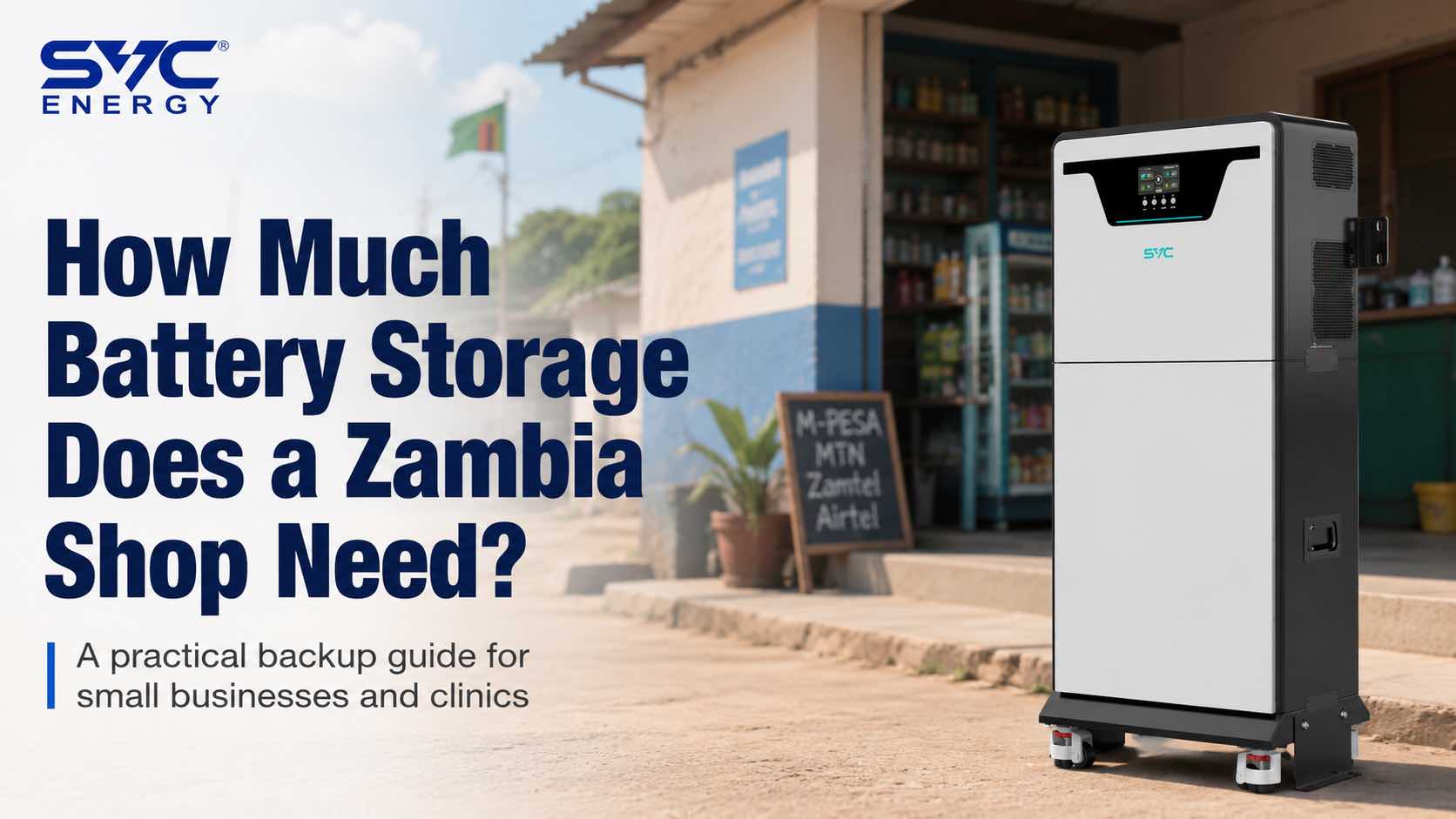
If you run a shop or clinic in Zambia, the real question is not “What is the biggest battery I can buy?” It is “What must keep running when ZESCO power goes off, and for how many hours?”
For many small shops, a practical battery range is 8kWh to 16kWh. For clinics, pharmacies, cold rooms, and shops with several fridges or freezers, the range is often closer to 16kWh to 30kWh or more. The exact number depends on the load list and daily load shedding hours.
Zambia’s recent power challenges have made this a serious business question. Drought pressure on hydropower has contributed to long power cuts, while Zambia has also been adding solar projects to diversify electricity supply. For a small business, battery storage is not only about comfort. It can protect medicine, food, cold drinks, payment systems, lighting, and customer trust.
For a small shop: start with 8kWh to 10.5kWh
A basic shop normally needs backup for lighting, a router, POS machine, phone charging, one fan, and maybe one fridge.
Example essential loads:
Lights: 150W
Router and POS: 50W
Fan: 80W
Small fridge average load: 150W
Other small loads: 100W
Total average load: about 530W, or 0.53kW.
If load shedding lasts 8 hours, the shop needs:
0.53kW × 8 hours = 4.24kWh raw energy.
After allowing for battery reserve and inverter losses, the real battery size should be around 6kWh to 7kWh minimum. In practice, an 8kWh or 10.5kWh system gives more breathing room.
This is where an all-in-one system can make sense. For example, an SVC 3.6kW + 8kWh all-in-one system or 6kW + 10.5kWh all-in-one system can suit a shop that wants a cleaner, easier backup setup without building a large custom system.
For a shop with freezer loads: consider around 16kWh
A shop with a freezer or drink fridge needs more caution. Refrigeration loads cycle on and off, and compressor startup can require higher surge power than the running wattage suggests.
Example shop load:
Lights: 200W
Router, POS, charging: 80W
Fans: 150W
Display fridge: 250W average
Freezer: 500W average
Other small equipment: 150W
Total average load: about 1.33kW.
For 8 hours of backup:
1.33kW × 8 hours = 10.64kWh raw energy.
After reserve and inverter losses, this can require around 14kWh to 16kWh of battery capacity. A 10kWh battery may work only if the load is carefully controlled, but it may feel too small during longer load shedding or hotter days when fridges run harder.
For this kind of shop, SVC’s 16.08kWh LiFePO4 battery is a stronger match. It gives more room for refrigeration and longer business hours, especially when paired with a suitable hybrid inverter.
For a clinic or pharmacy: plan 16kWh to 30kWh or more
A clinic or pharmacy should not size battery storage like a normal shop. The cost of losing power can be higher because medicine refrigeration, lighting, communication, and basic medical devices may be critical.
A small clinic might need to support:
Medicine or vaccine refrigerator
Treatment room lights
Reception computer
Router and phone charging
Small diagnostic device
Security system
Fans or ventilation
Water pump, if required
Example clinic load:
Medical fridge: 200W average
Lighting: 300W
Router and communication: 80W
Computer and small devices: 300W
Fans: 200W
Water pump average allowance: 300W
Total average load: about 1.38kW.
For 10 hours of backup:
1.38kW × 10 hours = 13.8kWh raw energy.
After reserve and inverter losses, this may require around 19kWh to 22kWh of installed battery capacity. If the clinic has more refrigeration, lab equipment, longer backup hours, or no reliable daytime recharge, 30kWh or more may be safer.
For clinics, the system should be designed with an essential-load circuit. Not every socket should run from the battery. The backup system should prioritize medical refrigeration, lighting, communication, and critical devices first.
Do not size the battery from inverter kW alone
A common mistake is to say, “I have a 6kW inverter, so I need a 6kWh battery.” That is not how backup sizing works.
Inverter kW tells you how much power the system can deliver at one time. Battery kWh tells you how long it can deliver power.
A 6kW inverter with a small battery may start many appliances, but the battery can drain quickly. A larger battery with an undersized inverter may store enough energy but fail when a pump, freezer, or compressor starts. Shops and clinics need both: enough inverter power for startup loads, and enough battery kWh for the number of backup hours.
A simple sizing formula
Use this practical formula:
Battery kWh needed = essential load in kW × backup hours ÷ usable battery percentage ÷ inverter efficiency
For many lithium battery systems, a planning assumption might use 80% usable battery capacity and around 90% inverter efficiency.
Example:
Essential load: 1.2kW
Backup time: 8 hours
Raw energy: 9.6kWh
Adjusted battery size: 9.6 ÷ 0.8 ÷ 0.9 = about 13.3kWh
So the practical recommendation would be around 16kWh, not 10kWh.
This is only a calculation example. Actual runtime depends on load behavior, battery settings, inverter efficiency, installation quality, temperature, and whether solar or grid charging is available during the day.
When does a three-phase system become necessary?
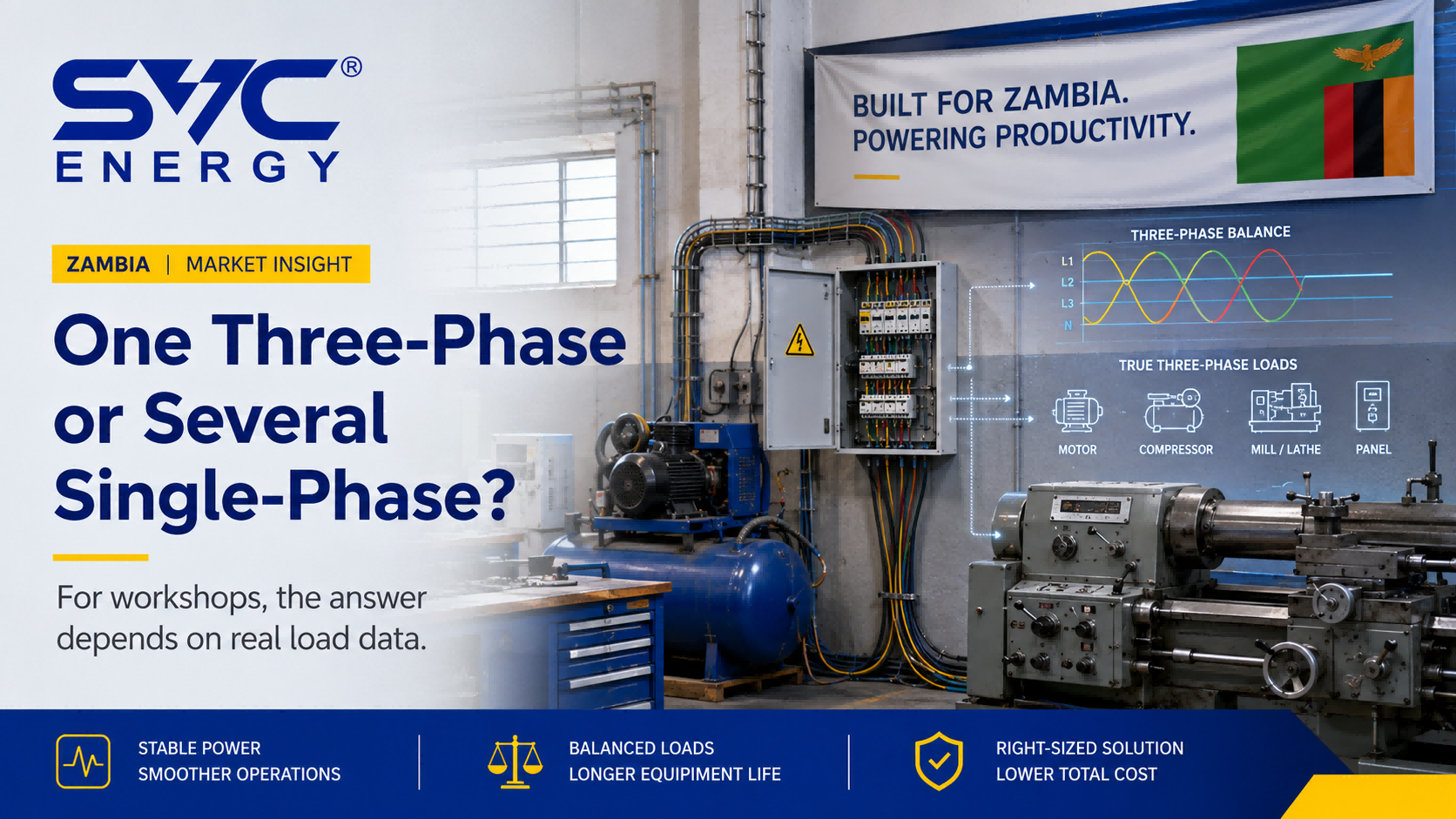
Some Zambian businesses need more than a normal single-phase shop backup system. If the site uses pumps, compressors, larger cold rooms, workshop tools, or three-phase equipment, the system should be designed as a small commercial project.
In that case, a low-voltage three-phase hybrid inverter can be more suitable than trying to parallel several single-phase units. SVC’s low-voltage three-phase hybrid inverter range, including the 20kW class, is relevant for small commercial sites that need direct three-phase output, diesel generator integration, and battery expansion.
For a clinic, this can matter if the site has water pumping, larger refrigeration, or multiple critical rooms. For a shop, it can matter if the business has cold storage, food processing, or heavier motor loads.
Practical capacity guide for Zambia
For a very small shop with lights, POS, router, fan, and phone charging:
5kWh to 8kWh may be enough, but 8kWh gives safer reserve.
For a normal shop with one fridge:
8kWh to 10.5kWh is usually a more practical starting range.
For a shop with freezer or longer evening business hours:
Around 16kWh is often more realistic.
For a pharmacy or small clinic:
16kWh to 30kWh is a safer planning range, depending on refrigeration and medical loads.
For a clinic, cold room, or small commercial site with pumps or three-phase equipment:
A custom hybrid system with larger battery capacity and proper inverter sizing is needed.
Conclusion
A Zambian shop or clinic should choose battery storage by starting with essential loads, not by guessing from product labels. Many small shops can start around 8kWh to 10.5kWh. Shops with freezers often need around 16kWh. Clinics, pharmacies, and sites with critical refrigeration may need 16kWh to 30kWh or more.
The best system is not simply the largest battery. It is the system that keeps the right loads running during daily load shedding, protects the business, and leaves enough reserve for real operating conditions.
Is an All-in-One Solar Battery System Easier to Install in a Kenyan Apartment or Townhouse?
What Solar Battery Products Are Easiest for Nigerian Distributors to Sell to Homes and Small Shops in 2026?
Related Article