Do I Still Need a Solar Battery in Zambia If Load Shedding Has Reduced in 2026?
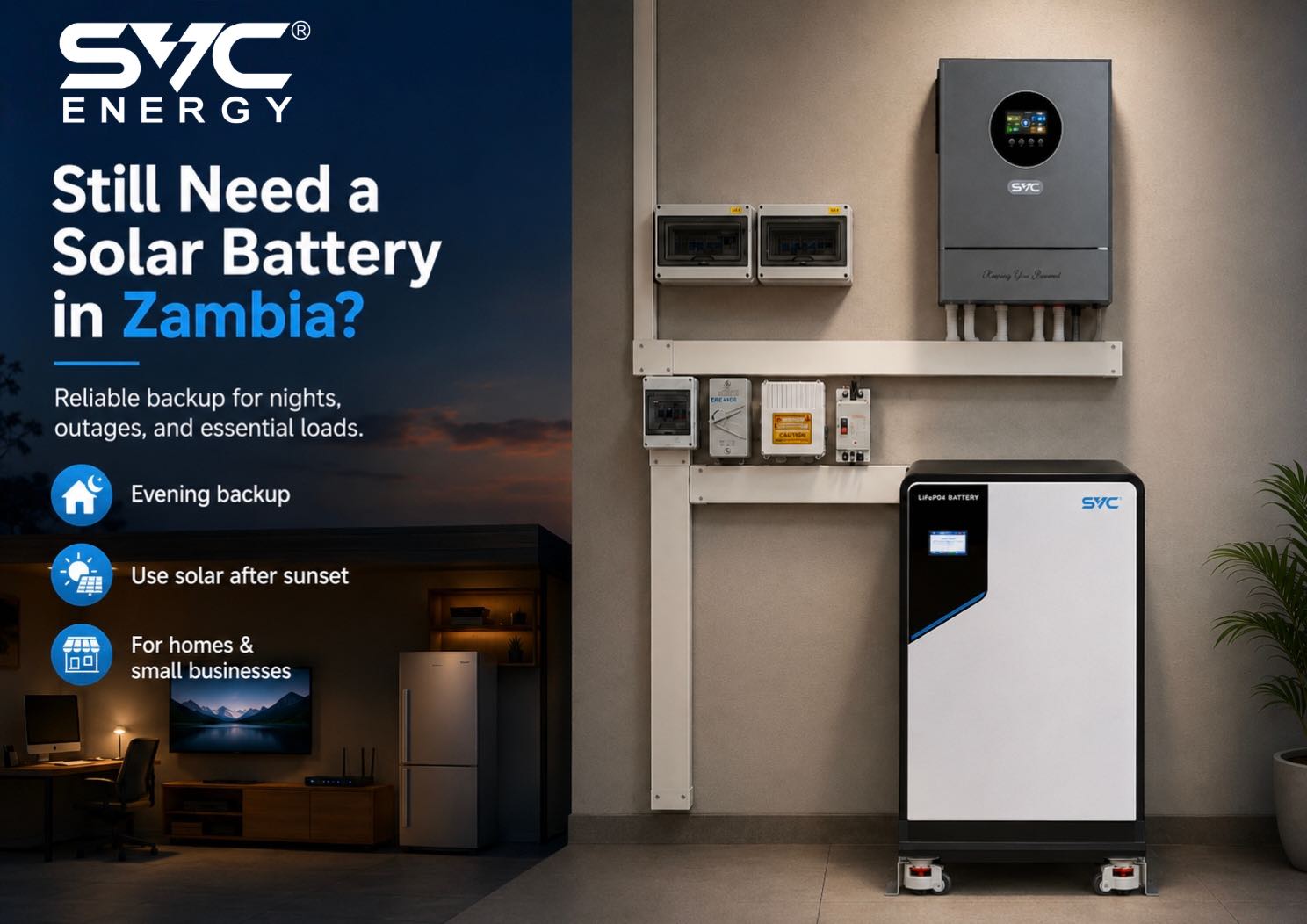
Do I Still Need a Solar Battery in Zambia If Load Shedding Has Reduced in 2026?
Yes, you may still need a solar battery in Zambia even if load shedding has reduced in 2026, especially if you need reliable power after sunset, during local outages, or for business-critical equipment. Reduced load shedding does not remove every power risk. It only changes the question: you are no longer buying a battery only for emergency blackouts, but for energy security, night backup, and better use of daytime solar power.
For many Zambian homes, shops, farms, and small businesses, the decision should depend on what happens when power fails, not only on whether the national load shedding schedule has improved.
Who Still Needs a Solar Battery in Zambia?
| Buyer Type | Battery Decision | Why |
|---|---|---|
| Home with lights, router, TV, fridge | Recommended if evening backup matters | Solar panels alone cannot power night loads without storage |
| Shop, salon, pharmacy, or office | Recommended | Even short outages can affect sales, payment systems, cooling, and security |
| Farm or rural user with water pump | Often needed | Pumps and rural supply require stable backup planning |
| Clinic or medicine storage site | Strongly recommended | Critical loads need predictable power |
| Small factory or workshop | Recommended if downtime is costly | Machines, tools, and motors need stable power design |
| Daytime-only solar user | Not always urgent | If you only want to reduce daytime grid use, battery can wait |
| Buyer with limited budget | Prepare first | Choose a battery-ready hybrid inverter, then add stor |
The simple rule is this: if losing power after sunset causes cost, risk, or serious inconvenience, a solar battery still has value.
Why Reduced Load Shedding Is Not the Same as Reliable Power
Lower load shedding is good news, but it does not guarantee uninterrupted electricity. Homes and businesses may still face local transformer faults, maintenance shutdowns, weak distribution lines, voltage instability, weather-related outages, and evening demand peaks.
Zambia also remains exposed to hydropower risk. When water levels fall, power generation can become less predictable. That is one reason solar-plus-storage projects are becoming more important in Zambia’s energy mix.
For a household or business, battery storage plays the same role at a smaller scale: it stores energy when power is available and protects the loads that matter when power is not available.
Solar Panels Alone Are Not Battery Backup
Many buyers confuse solar panels with full backup power. They are not the same.
| System Type | What It Solves | What It Does Not Solve |
|---|---|---|
| Solar panels only | Reduces daytime grid use | Does not store power for night |
| Solar + inverter without battery | Supports some daytime loads | Limited backup when grid fails |
| Solar + battery | Stores solar energy for night and outages | Must be sized correctly |
| Solar + battery + grid/generator charging | Gives more flexible backup | Needs proper inverter settings |
If your main goal is lower daytime electricity use, solar panels may be enough. If your goal is power security after sunset, you need battery storage.
When Can You Wait Before Buying a Battery?
You may be able to wait if your grid supply is stable, you do not need night backup, and your main goal is only to reduce daytime electricity use. But even then, it is better to choose a battery-ready hybrid inverter.
This gives you a safer upgrade path. You can install solar first, then add LiFePO4 battery storage later when your budget or backup needs grow.
What Type of Battery Makes Sense?
For frequent backup use, LiFePO4 lithium batteries are usually more practical than lead-acid batteries because they offer higher usable capacity, longer cycle life, smart BMS protection, lower maintenance, and easier expansion.
SVC standalone lithium batteries use LiFePO4 chemistry, Grade A battery cells, smart BMS management, app monitoring, and support parallel expansion up to 16 units. For Zambian homes and small businesses that need longer evening backup, SVC’s 10.5kWh and 16.08kWh lithium battery options can be matched with hybrid inverters for a more reliable backup system.
For buyers who want a simpler installation, SVC all-in-one solar storage systems combine inverter and battery in one unit, helping reduce wiring complexity and communication mismatch between different brands.
Conclusion
If load shedding has reduced in Zambia, not every buyer needs to rush into buying a battery. But if you need reliable evening power, business continuity, refrigeration, security, pump operation, or protection against local outages, a solar battery is still worth considering.
The better question is not only, “Is load shedding reduced?” It is: “What do I need to keep running when the grid is not available?”
FAQ
Do I still need a solar battery in Zambia if load shedding has reduced?
Yes, if you still need backup power for evening loads, local outages, refrigeration, business continuity, pumps, or security systems.
Can solar panels work at night without a battery?
No. Solar panels only produce power when there is sunlight. A battery is needed to store energy for night use.
Is battery storage still useful if the grid is more stable?
Yes. A stable grid reduces emergency use, but battery storage can still protect essential loads and make daytime solar power useful after sunset.
Should I buy a battery now or prepare for later?
If you need night backup now, buy a properly sized battery. If your budget is limited, install a battery-ready hybrid inverter first and add storage later.
What battery type is better for daily backup?
LiFePO4 lithium batteries are a strong option for daily backup because they provide higher usable capacity, smart BMS protection, long cycle life, and easier expansion.
CTA
Need help deciding whether a solar battery still makes sense for your home, shop, farm, or business in Zambia? Share your essential loads, backup-hour target, and current power source. SVC can help match the right LiFePO4 battery, hybrid inverter, or all-in-one solar storage system for your site.
Which Lithium Battery Features Matter Most for Kenyan Installers: CAN, RS485, WiFi or App Monitoring?
Why Solar Batteries Drain Fast at Night in Nigeria Even with Small Appliances
Related Article