Can I Charge a Home Battery from the Grid Only If My Kenyan Apartment Cannot Install Solar Panels?
Direct Answer
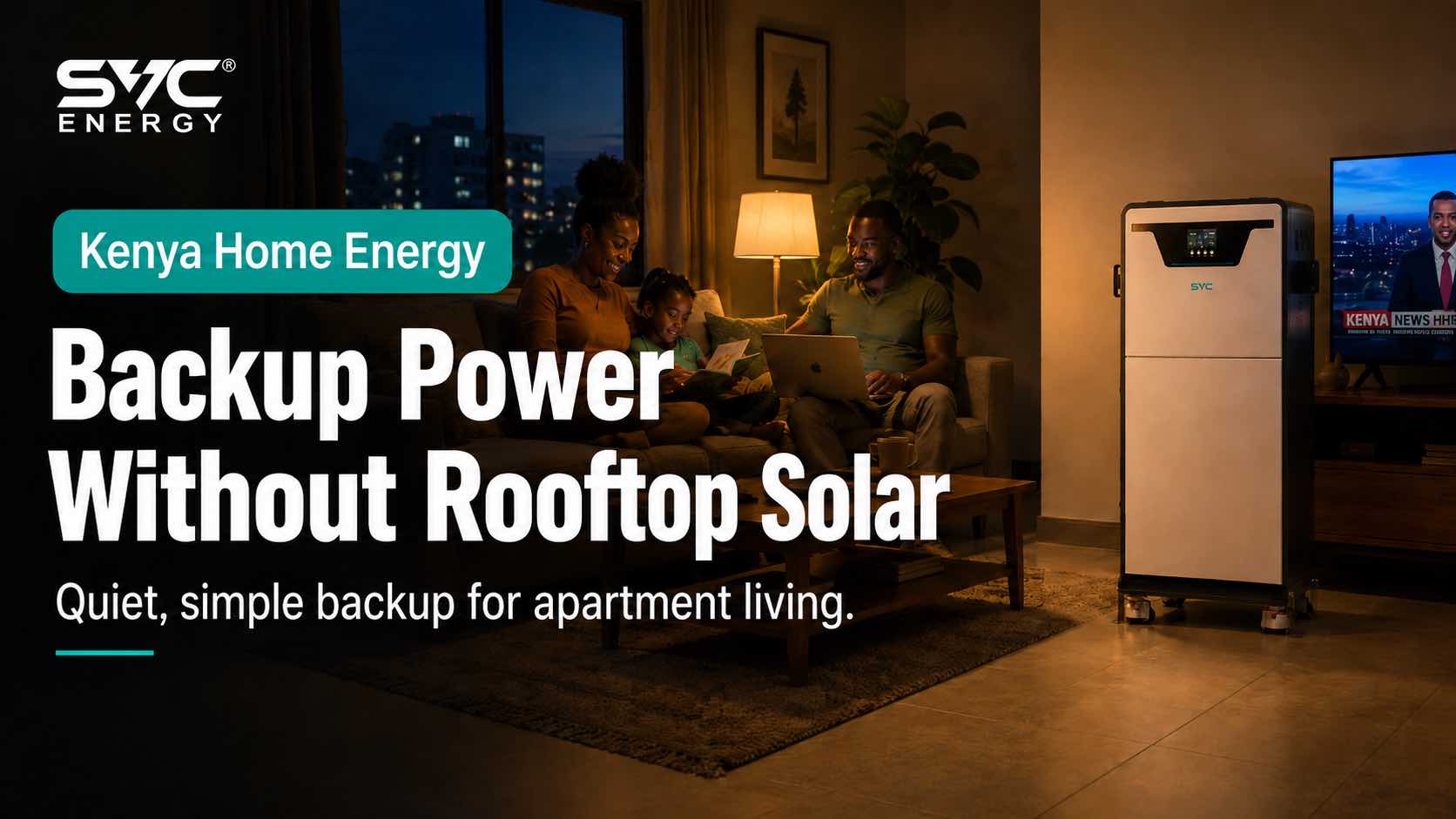
Yes, you can charge a home battery from the grid only if your Kenyan apartment cannot install solar panels. The system stores electricity when grid power is available and supplies backup power when the grid goes off.
This setup is useful for apartments, rented homes, and townhouses where roof access is limited or landlord approval is difficult. But it has one important limit: without solar panels, the battery cannot recharge from sunlight. It depends fully on grid availability.
Why This Question Is Common in Kenyan Apartments
Many Kenyan apartment buyers do not start by asking for a complete solar system. Their real question is usually more practical:
“Can I keep my Wi-Fi, laptop, lights, phone, TV, CCTV, or fridge running without installing panels on the roof?”
That is a very apartment-specific problem. A tenant may not own the roof. A building may have shared roof space. A landlord or estate manager may not allow solar panel installation. Some apartments also do not have a clean cable route from the roof to the unit.
In this situation, a grid-charged battery can be a useful middle path. It gives backup power without requiring immediate rooftop solar installation.
What Can a Grid-Charged Battery Run?
For a Kenyan apartment, the best use case is essential backup.
Typical suitable loads include:
Wi-Fi router
Laptop
Phone charging
LED lights
TV
CCTV or security device
Small fan
Small fridge, if the system is sized properly
Loads to avoid unless the system is specifically designed for them:
Kettle
Iron
Electric cooker
Water heater
Large microwave
High-power AC
Heavy pump
The main point is simple: a grid-charged battery should protect the most important daily loads, not run every appliance in the apartment.
How Does It Work Without Solar Panels?
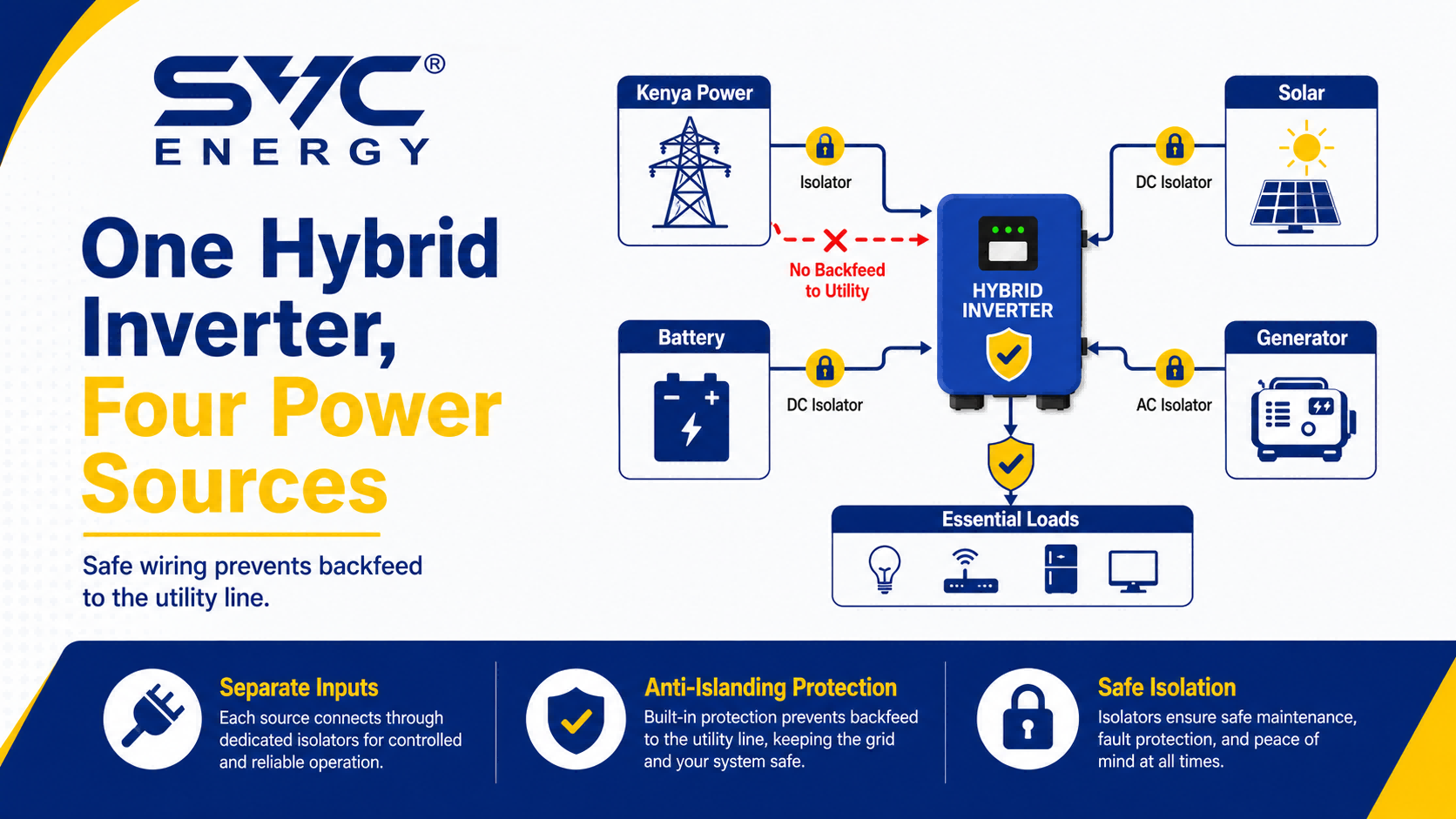
A grid-charged backup system normally includes an inverter/charger and a lithium battery. When grid power is available, the inverter charges the battery. When power fails, the inverter switches to battery backup for selected loads.
Some all-in-one systems are especially suitable for this kind of buyer because they combine the inverter and battery in one matched unit. This reduces wiring complexity and avoids some inverter-battery communication problems.
For example, an SVC 1.2kW + 4kWh solar generator can fit very basic apartment backup needs such as lights, phone charging, router, laptop, and small daily loads. For a more comfortable apartment or townhouse backup setup, an SVC 3.6kW + 8kWh all-in-one system or 6kW + 10.5kWh all-in-one system may be more relevant, depending on the appliance list.
What Is the Main Limitation?
The limitation is recharge timing.
If the grid returns for only a short time, the battery may not fully recharge before the next outage. Without solar panels, you cannot use daytime sun to help recharge it.
Before buying, ask the installer:
How fast can the battery recharge from grid power?
What AC charging current is safe for this battery?
Can the system automatically charge when grid power returns?
Can I set a battery reserve level?
Will the battery app show charge status and warnings?
This matters because backup time is not only about battery size. It is also about how often and how fully the battery can recharge.
Should the Whole Apartment Be Connected?
Usually, no.
For an apartment, it is safer and more practical to connect selected backup loads. A dedicated backup circuit or selected backup sockets help prevent the battery from being drained by high-power appliances.
A simple apartment backup plan may include:
Router socket
Light circuit or selected lamps
TV socket
Laptop/phone charging socket
Small fridge socket, if sized
The installer should clearly label backup sockets and explain what should not be plugged into them.
If someone plugs an iron, kettle, or cooker into the backup socket, the inverter may overload or the battery may drain very fast.
Is This Better Than Buying a Small Portable Power Station?
It depends on the buyer’s goal.
A small portable unit is easier for renters who only need phone charging, router backup, and one or two lights. It is simple, movable, and does not require much installation.
A fixed home battery system is better when the buyer wants a cleaner setup, more battery capacity, inverter backup for selected sockets, app monitoring, and future expansion.
If you may later move to a house or get roof access, choosing a system that can accept PV input later is useful. That way, the battery can start as grid-charged backup and later become part of a solar-plus-storage system.
What Should You Ask Before Buying?
Before paying, ask:
Can this system work safely as grid-charged backup without solar panels?
Which loads will be connected?
How many watts do those loads use?
How many hours of backup can I expect under those assumptions?
What is the inverter power rating?
What is the battery kWh capacity?
How fast can the battery recharge from grid power?
Can I add solar panels later if roof access becomes available?
Where will the battery be placed safely inside the apartment?
Does the system include BMS/app monitoring?
A good installer should answer these with a load list, not just a price.
Practical Recommendation for Kenyan Apartments
If you only need Wi-Fi, laptop, phone charging, and a few lights, start with a small grid-charged backup system.
If you also want TV, CCTV, fan, or a small fridge, consider a larger all-in-one system with enough battery kWh and inverter power.
If you want to run kitchen heating appliances or AC, a basic apartment battery backup is usually not the right solution unless the system is specifically sized for those loads.
The best setup is one that matches your apartment lifestyle: quiet backup, clean wiring, safe indoor placement, and clear limits on what the battery should power.
Conclusion
A Kenyan apartment can use a home battery charged from the grid only when solar panels are not possible. This is a practical option for renters, apartment owners, and townhouses with roof restrictions.
The system is best for essential backup: Wi-Fi, lights, laptop, phone charging, TV, CCTV, and possibly a small fridge. It is not a full solar system until PV panels are added, and it should not be sold as whole-apartment backup unless the inverter and battery are properly sized.
For most buyers, the smartest path is to start with a safe grid-charged battery backup system, keep heavy appliances off the backup circuit, and choose equipment that can add solar panels later if the installation situation changes.
Which Solar Battery Packages Should Nigerian Distributors Prepare for Homes, Clinics and Phone Charging Shops?
If I Can Only Afford One Battery, Should I Choose Longer Backup Time or Higher Inverter Power in Zambia?
Related Article