Why Does My Inverter Shut Down When ZESCO Power Comes Back or When the Fridge Starts?
Direct Answer
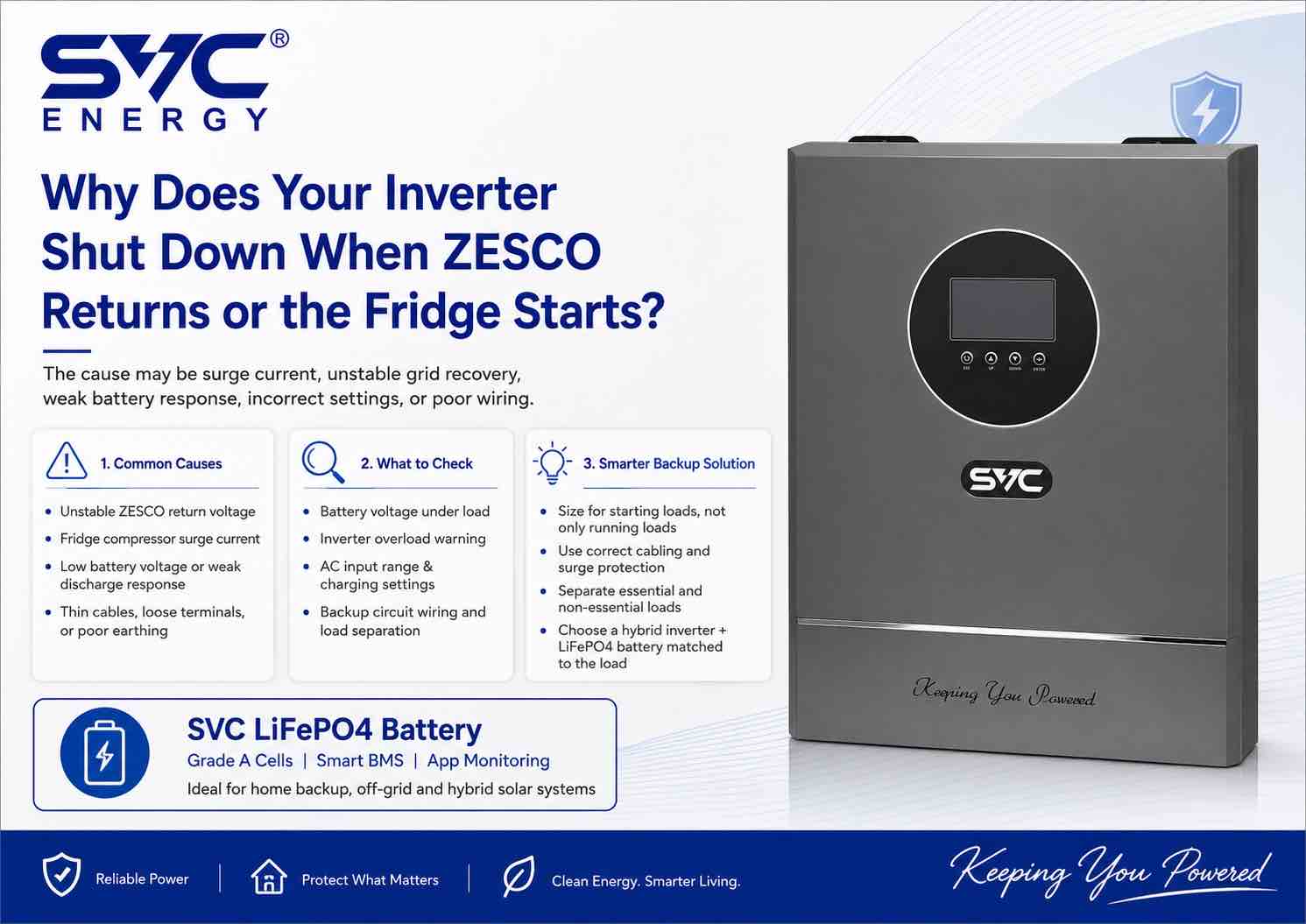
Your inverter may shut down when ZESCO power comes back or when the fridge starts because the system is seeing a sudden power surge, voltage change, overload, weak battery response, or incorrect AC input setting. In many Zambia homes and shops, the problem is not only the inverter. It can also come from undersized battery cables, poor earthing, low battery voltage, or appliances with high starting current.
This is a common issue for buyers using load shedding backup power Zambia systems, especially when a fridge, freezer, pump, salon machine, compressor, or small commercial appliance starts suddenly.
Why It Happens During ZESCO Load Shedding Recovery
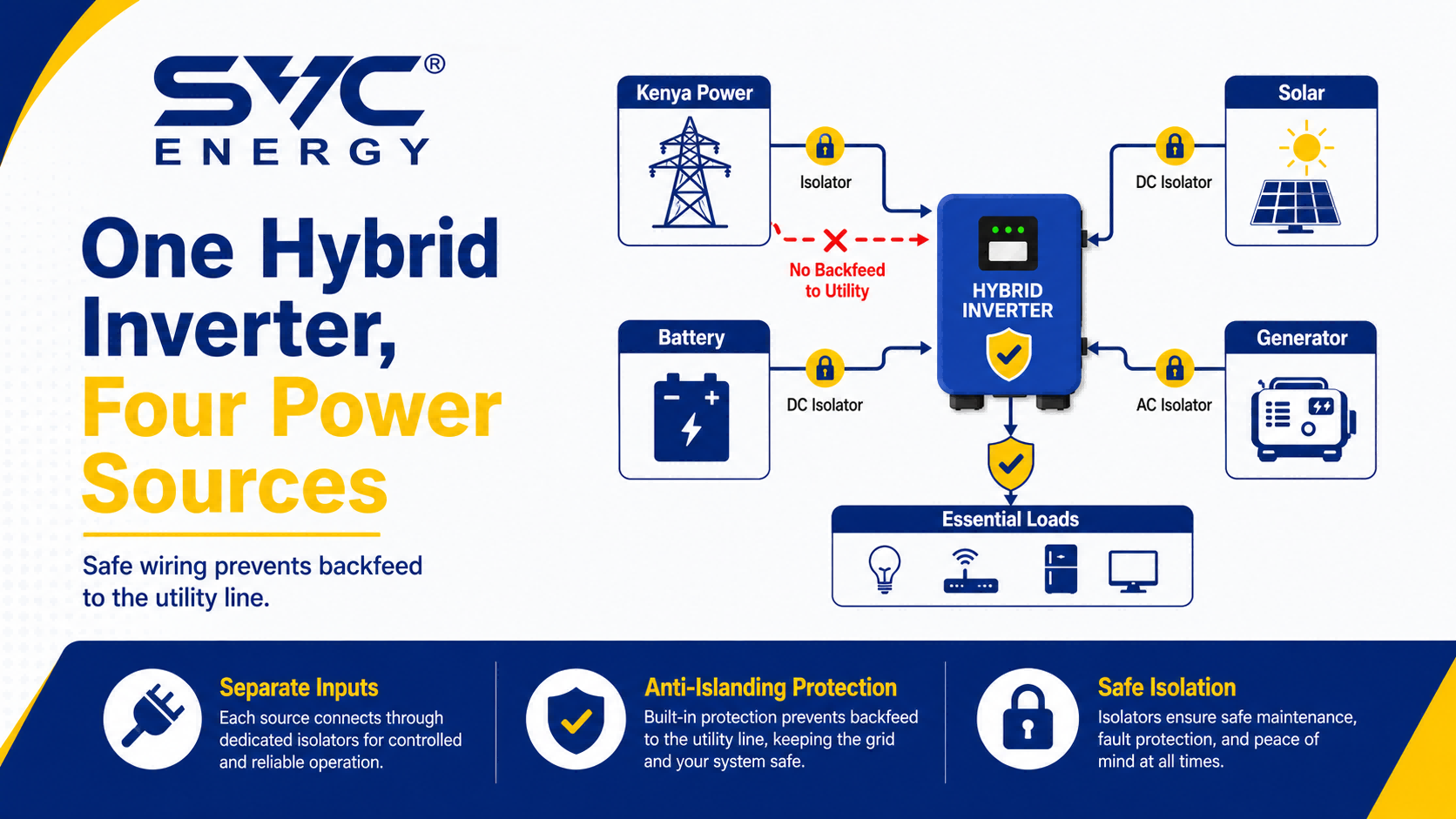
When grid power returns after load shedding, your inverter must switch from battery mode to utility charging or bypass mode. If the grid voltage is unstable, the inverter may reject the input or restart to protect itself.
This can happen when:
- ZESCO voltage comes back too low or too high.
- The inverter AC input range is set too narrow.
- The battery is already too low after long backup use.
- The charger starts too aggressively and causes a sudden current demand.
- The installation has weak cabling or loose terminals.
- The neutral and earth wiring is not handled correctly.
- Heavy appliances start at the same moment power returns.
For ZESCO load shedding backup power, the system must be designed for both outage time and recovery time. Many users focus only on backup hours, but the transition back to grid is just as important.
Why the Fridge Makes the Inverter Trip
A fridge does not use the same power all the time. When the compressor starts, it can briefly demand several times more power than its normal running wattage. A fridge that runs at 150W or 250W may need much higher surge power for a short moment.
Your inverter can shut down if:
- The inverter is too small for the fridge starting surge.
- The battery cannot deliver enough instant current.
- The battery is old, low, or not fully charged.
- Battery cables are too thin or too long.
- The fridge shares the same circuit with other heavy loads.
- The inverter overload protection reacts faster than the appliance stabilizes.
This is why a home backup power Zambia system should be sized from starting loads, not only running loads. Fridges, freezers, pumps, irons, kettles and compressors need special attention.
What to Check Before Buying a New Inverter
Do not replace the inverter immediately. First, ask your installer to check the full solar backup system Zambia configuration.
Start with these checks:
- Check the battery voltage when the fridge starts. If voltage drops sharply, the battery or cable may be the issue.
- Check whether the inverter overload warning appears before shutdown.
- Check whether the fridge is connected to the essential load circuit.
- Check if other appliances start at the same time.
- Check all battery cable sizes, lugs and terminals.
- Check AC input voltage when ZESCO returns.
- Check inverter AC input range and charging current settings.
- Check earthing, neutral wiring and changeover connection.
- Check whether the battery BMS is cutting off discharge.
- Check whether the inverter is overloaded by hidden loads.
For power outage backup power Zambia, a stable system needs the right inverter, enough battery current, correct wiring and clear load priority.
When the Battery Is the Real Problem
Sometimes the inverter shuts down because the solar battery backup Zambia system cannot support the surge current. This can happen even when the battery still shows some remaining percentage.
Battery-related warning signs include:
- Battery percentage drops very fast when the fridge starts.
- The inverter shows low battery even after charging.
- Backup time is much shorter than expected.
- The battery shuts off before the inverter overloads.
- The system works for lights and TV but fails with fridge or pump.
- The problem becomes worse during long ZESCO load shedding schedule periods.
For buyers using lithium batteries, check whether the battery has a smart BMS and enough continuous discharge current for the inverter and appliances. SVC standalone LiFePO4 batteries use smart BMS management, Grade A cells, app monitoring support, and are designed for home backup, off-grid and hybrid solar systems. For homes that need longer backup for fridges, lights, TV, router and occasional heavier loads, a 10.5kWh or 16.08kWh LiFePO4 battery is more suitable than a very small battery.
When the Inverter Size Is Too Small
If your inverter shuts down only when the fridge, pump or freezer starts, the inverter may not have enough surge capacity. A system that looks fine on paper can still fail if the installer only calculated running watts.
A simple example:
If your home uses lights, TV, router and a fridge, the normal running load may look moderate. But when the fridge compressor starts while the TV and lights are already on, the inverter must handle the sudden peak. If the battery is also low after several hours of ZESCO load shedding, shutdown becomes more likely.
This is why a hybrid inverter should be selected with enough margin. SVC hybrid inverter options include models with lithium battery activation, PV operation, wide MPPT ranges on applicable models, and load management features depending on model. These are helpful for Zambia homes and shops, but the system still needs proper sizing by load type.
What Settings Can Help?
Your installer may be able to improve stability by adjusting inverter settings. Do not change advanced settings unless you understand the system or have installer support.
Useful settings to review include:
- AC input voltage range
- Battery low-voltage cut-off
- Battery charging current
- Utility charging priority
- Solar charging priority
- Output priority
- Bypass mode
- Overload restart behavior
- Lithium battery communication setting
- Generator/grid input tolerance if used
For ZESCO prepaid solar backup systems, it is also important to confirm whether the inverter is connected correctly after the prepaid meter and whether the backup circuit is separated from non-essential loads.
What If the Problem Happens During ZESCO Faults?
ZESCO faults backup power issues can be different from normal load shedding. During a fault, voltage may fluctuate, return briefly, drop again, or come back with unstable quality. Some inverters will disconnect to protect the battery and appliances.
If your inverter trips mainly during faults, ask your installer to check:
- Surge protection
- Earthing quality
- AC input voltage stability
- Changeover switch wiring
- Whether the inverter is exposed to repeated grid flicker
- Whether sensitive appliances need a separate protection device
For commercial backup power Zambia users, this is especially important. Shops, clinics, warehouses, cold rooms and small workshops can lose money if the system restarts repeatedly after every grid disturbance.
Practical Fixes That Usually Work
The most common fixes are straightforward when the cause is identified:
- Move the fridge or freezer to the correct essential-load circuit.
- Remove heavy appliances from the backup circuit.
- Increase inverter capacity if surge demand is too high.
- Upgrade battery cables and tighten all terminals.
- Add enough battery capacity for longer load shedding periods.
- Adjust inverter input and charging settings.
- Improve earthing and surge protection.
- Use a hybrid inverter and lithium battery combination that supports the required discharge current.
- Ask for a proper load audit before expanding the system.
- Keep a written commissioning record after repair.
A good solar backup system Zambia installation should not only run during an outage. It should also restart smoothly when ZESCO power returns and handle normal appliance starting loads.
Soft Product Recommendation
For a Zambia home where the main loads are lights, router, TV, fridge and freezer, an SVC hybrid inverter paired with an SVC LiFePO4 battery can be a practical backup solution when properly sized. For longer backup hours or heavier loads, SVC 10.5kWh and 16.08kWh lithium battery options are more relevant than small backup packs.
For shops, clinics, salons, cold rooms or small commercial sites, the installer should calculate both running load and surge load before recommending the inverter size. Commercial backup power Zambia systems need more careful circuit separation because freezers, pumps, compressors and machines can start at different times.
FAQ
Why does my inverter work with lights but fail when the fridge starts?
Lights have low starting demand, while a fridge compressor needs a short surge current. If the inverter, battery or cables cannot handle that surge, the inverter may shut down.
Is the ZESCO load shedding schedule the reason my battery dies quickly?
The schedule itself is not the technical cause, but long outage hours can drain the battery deeply. When ZESCO power returns or a fridge starts, a low battery is more likely to trigger shutdown.
Can a bigger battery stop the inverter from tripping?
A bigger battery can help if the shutdown is caused by low voltage or weak discharge current. But if the inverter is too small or the wiring is poor, battery expansion alone may not solve the problem.
Should I choose a solar generator or a hybrid inverter for Zambia load shedding?
A solar generator can support light backup needs. A hybrid inverter with lithium battery storage is usually better for homes and businesses that need fridge, freezer, router, lights, TV, pumps or longer backup time.
What should I ask an installer before repairing the system?
Ask for a load audit, battery voltage test under load, cable inspection, inverter setting review, earthing check and explanation of which appliances are on the backup circuit.
What Solar Battery System Can Run a Rural Kenyan Home, Water Pump and Security Lights Off-Grid?
How to Protect Solar Panels and Batteries from Theft, Heat and Bad Wiring in Nigeria
Related Article