Going Off-Grid in Kenya: How Much Battery Do Cloudy Days Require?
Solar Insights · Kenya
Going Off-Grid in Kenya: How Much Battery Do Cloudy Days Require?
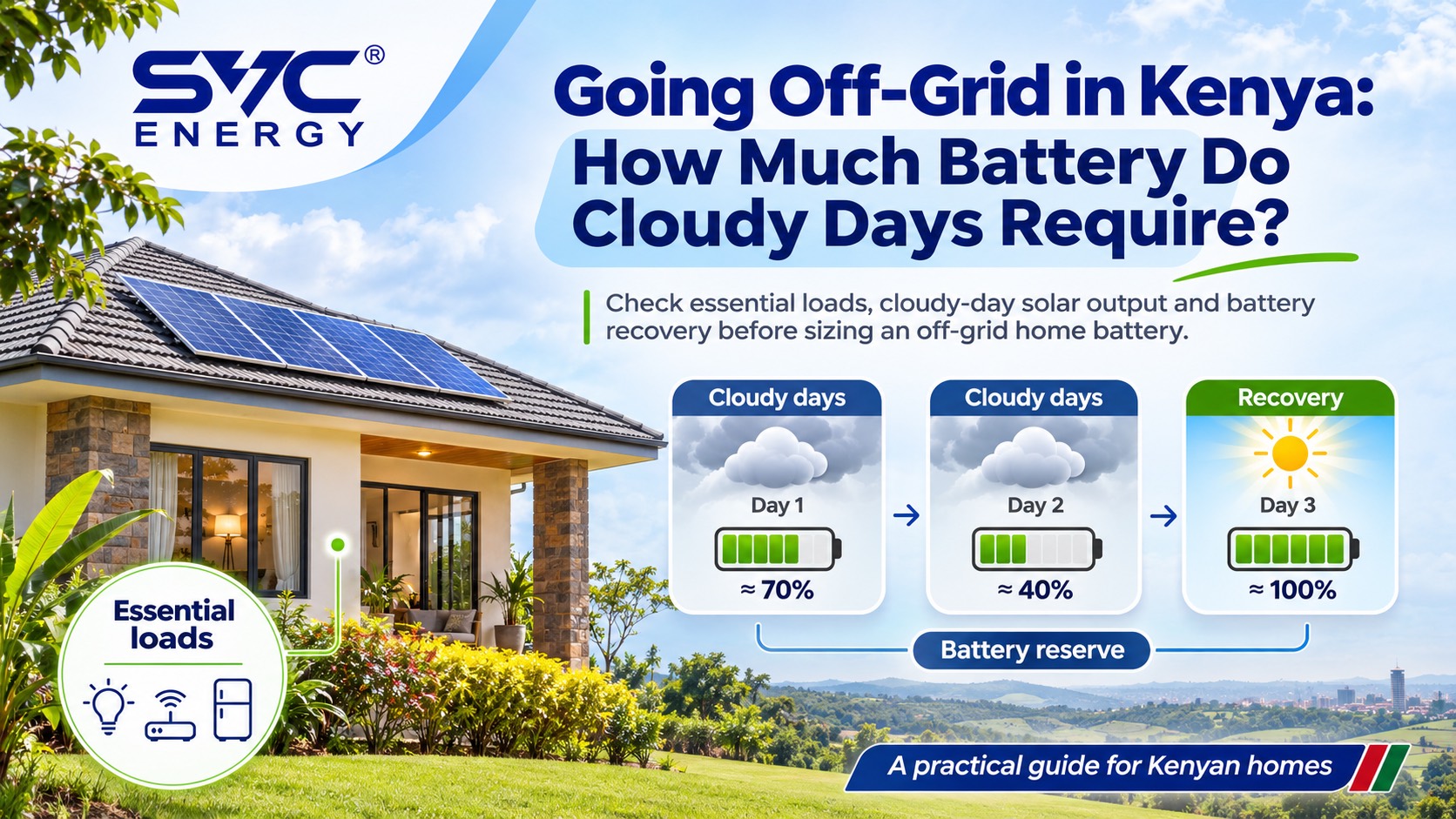
Test essential loads, poor-weather solar output and recharge recovery before sizing an off-grid battery for your Kenyan home.
Before going fully off-grid in Kenya, calculate how much energy your essential appliances need during poor weather, subtract a conservative estimate of solar generation, and check whether the battery can cover the remaining deficit. Then test how quickly it can recover. Avoid selecting storage from annual sunshine averages, roof size or a universal “three days of backup” rule.
What does “fully off-grid” mean for your household?
First decide whether you mean no electricity imports in normal weather, no grid connection at all, or no dependence on either the grid or a generator.
Those are different design targets.
Grid available
A home retaining Kenya Power as occasional backup can tolerate a smaller storage reserve than a home requiring all essential loads to run through several poor-weather days without another source.
Independent operation
A home without grid or generator support needs a design that can cover essential demand during extended periods of weak solar generation.
Off-grid design must address periods when generation is weak, not just normal sunny operation. Manufacturer guidance also identifies this poor-weather requirement as a reason off-grid storage can become much larger than everyday use suggests. Victron Energy storage guide
Decide which loads you would reduce during prolonged cloud before pricing the system.
Measure essential energy—not just total monthly consumption
Use appliance measurements or reliable energy-monitoring records to separate essential demand from discretionary use.
Essential loads might include refrigeration, selected lighting, communications and necessary pumping. Electric showers, cooking, laundry and other high-energy activities need explicit decisions rather than automatic inclusion.
Measure appliances across complete operating cycles. A refrigerator’s compressor does not run continuously, while a pump’s short operating time does not remove its starting-power requirement.
Ask for two load plans:
Normal household operation
Poor-weather essential-load mode
This creates a practical alternative to buying enough battery to run every appliance unchanged throughout an extended cloudy period.
Calculate the cloudy-day energy deficit
Consider a simplified example with these assumptions:
Solar contribution is expressed as an AC-equivalent amount after relevant generation-path losses.
Remaining energy required from storage
(5 − 1) × 2 = 8 kWh
Delivered to appliances.
Assume an 80% permitted usable battery fraction and 90% battery-to-AC conversion efficiency:
Estimated nominal battery capacity
8 ÷ (0.80 × 0.90) ≈ 11.1 kWh
This is only an illustrative starting point. It assumes the battery begins the period at its designated upper charge level. It excludes inverter standby consumption and additional allowances for ageing, temperature, forecast error and an operational reserve.
If the same two days produced no usable solar, the calculation becomes:
No usable solar contribution
10 ÷ (0.80 × 0.90) ≈ 13.9 kWh
The difference shows why a poor-weather production assumption matters. Neither figure is a universal recommendation for Kenyan homes.
Can the panels refill the battery afterwards?
Surviving cloudy days is only half the test. The array must also support normal loads while restoring the depleted battery.
Suppose the battery needs 9 kWh of replenishment after the event. If only 3 kWh per day reaches storage after household consumption and charging losses, recovery takes approximately three days.
Energy to replenish
9 kWh
Daily energy reaching storage
3 kWh
Recovery time
3 days
Another cloudy period during recovery could leave the system short.
Ask your installer to assess time-sequenced weather and load data for your location, including low-generation periods and recovery. A monthly average alone can hide several difficult days occurring together.
Additional battery capacity cannot compensate indefinitely for an array that produces too little energy.
How do you avoid oversizing?
Compare several designs against the same household requirement:
Retain occasional grid backup
This may reduce storage needs, although the system is no longer independent of the grid.
Use a poor-weather load plan
Deferring discretionary appliances can reduce required autonomy without compromising essential services.
Increase useful solar generation
Where roof space and equipment limits allow, this can improve recovery rather than merely adding storage.
Choose an approved expansion path
Start from measured needs, but verify future battery compatibility and expansion conditions before purchase.
For an SVC Energy system assessment, share your location, measured load profile, roof survey and required essential-load autonomy. Request the usable battery energy, permitted operating range, standby consumption and charging limits for the exact proposed equipment.
The Bottom Line
A well-sized off-grid system balances three things: energy needed through poor weather, power needed to run appliances, and generation available to recover afterwards.
Short ZESCO Supply Windows: More Solar Panels or a Bigger Battery First?
Related Article