Short ZESCO Supply Windows: More Solar Panels or a Bigger Battery First?
Solar Insights · Zambia
Short ZESCO Supply Windows: More Solar Panels or a Bigger Battery First?
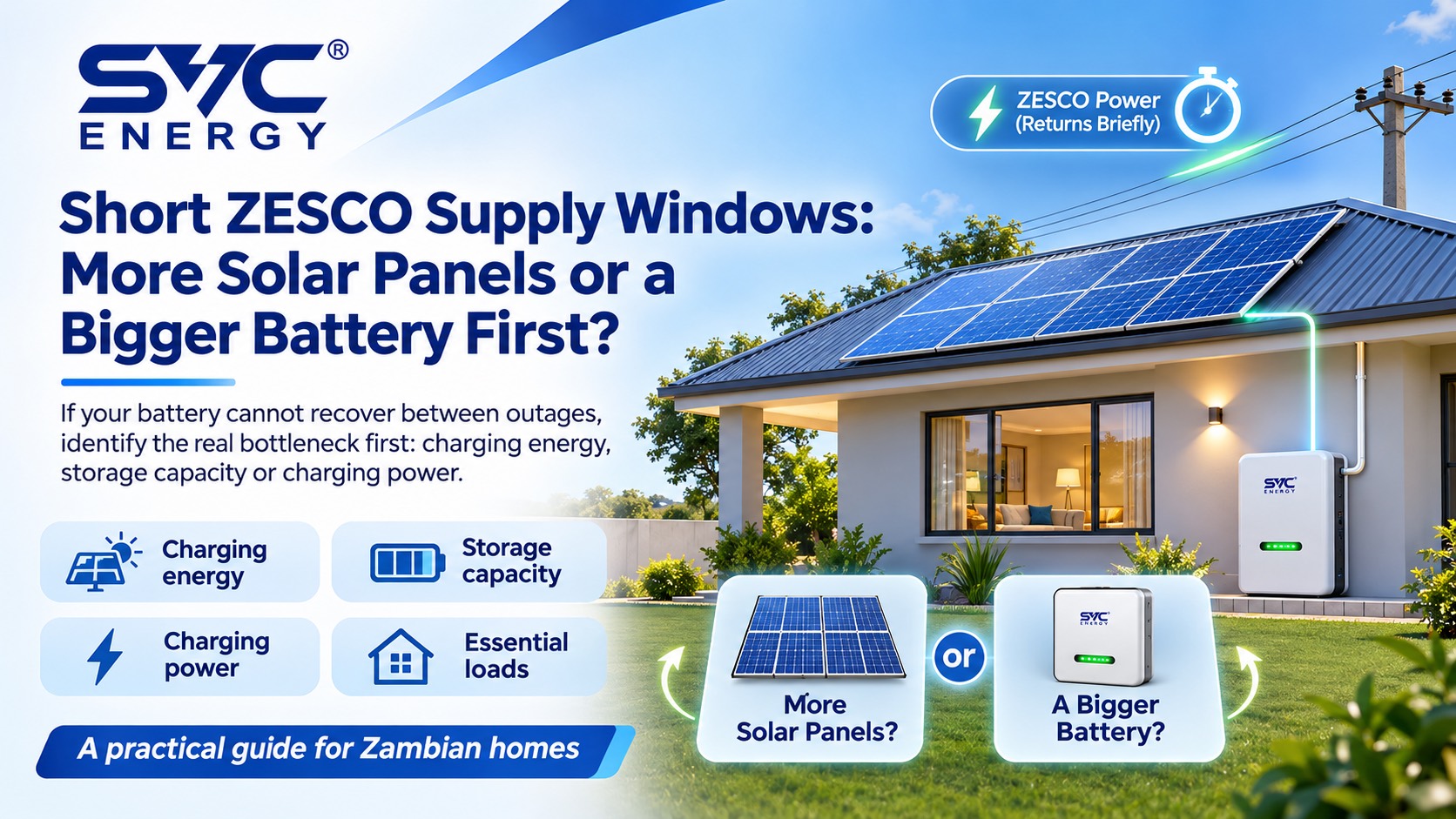
If your battery cannot recover between outages, identify whether you lack charging energy, storage capacity or charging power before spending more.
If ZESCO returns only briefly at your property, buy more panels first when insufficient charging energy is leaving the battery partly empty. Consider a bigger battery when the existing one regularly reaches its permitted charge target but cannot carry essential loads through the outage. If charging power is restricted, neither purchase alone may solve the problem. Check the energy flow before choosing equipment.
This is a guide for households experiencing short restoration windows—not a claim that every Zambian customer currently follows the same supply schedule.
Is your battery too small, or simply not getting charged?
A battery stores energy; it does not create it. Adding storage cannot sustainably fix a system that consumes more energy than solar and grid charging replace.
Observe several representative days. Record battery state of charge when power returns, when it goes off again, and before the next restoration. Include solar production, charging power and the appliances running during charging.
Three patterns point to different decisions.
The battery rarely reaches its permitted charge target.
Investigate inadequate solar production, short grid windows, excessive daytime consumption or charging restrictions.
The battery reaches its charge target but empties too early.
Additional usable capacity may help, provided the system can recharge that larger bank.
The battery shows substantial charge but appliances switch off.
Investigate inverter overload, battery current limits, communication faults or protection events. More kWh is not automatically the answer.
State-of-charge readings are useful clues, not conclusive capacity tests. Ask the installer to validate suspicious readings against measured energy and battery logs.
How much energy can a short charging window replace?
Suppose your essential appliances use an average of 500 watts during a six-hour interruption:
Energy delivered to appliances
0.5 kW × 6 hours = 3 kWh
At an assumed 90% battery-to-AC efficiency, approximately:
Energy that must leave the battery
3 ÷ 0.90 = 3.33 kWh
Excluding inverter standby consumption.
Now suppose the charger can deliver an average of 1 kW into the battery for a two-hour restoration window:
Energy restored during the grid window
1 kW × 2 hours = 2 kWh
The battery has not recovered the energy removed. Battery storage losses may widen that gap.
A larger battery could delay the next shutdown, but repeated cycles with an energy deficit will eventually deplete it. The first task is to close the deficit through more charging energy, a longer charging opportunity, reduced consumption or a combination.
These numbers are illustrative. They are not a forecast of ZESCO supply or a guarantee of equipment performance.
When should solar panels come first?
Additional panels deserve priority when useful daylight is available, the battery is consistently undercharged, and the inverter’s solar inputs can safely accept a larger array.
However, check whether the apparent generation shortfall comes from shading, dirt, a wiring fault, controller limits or incorrect settings. Adding panels without diagnosing the cause can waste money.
Important design check
Ask the installer to estimate additional energy reaching the battery after daytime household loads, not just the new array’s nameplate watts.
An existing controller may already be at its voltage, current or power limit. Panel additions require a model-specific design check, including string voltage and roof conditions.
When should battery capacity come first?
A larger battery is more relevant when energy is available to fill it but the existing bank cannot cover the required evening or outage period.
For example, repeated midday solar curtailment while the battery is full, followed by insufficient overnight backup, can indicate a storage opportunity. Confirm this through logs rather than a single sunny day.
Before expansion, check the approved battery combinations, communication requirements, current limits and installation space. Do not assume that different batteries—or different generations of the same family—can be connected together.
What should your first upgrade proposal include?
Request a proposal showing:
- Essential-load energy per outage.
- Measured grid and solar charging opportunities.
- The present bottleneck and evidence supporting it.
- Expected performance after the proposed upgrade.
- A lower-cost alternative based on shifting or removing discretionary loads.
Moving suitable daytime activities into solar hours may reduce battery cycling and the capacity required. The installer must still verify that the inverter and wiring can support those loads.
For an SVC Energy proposal, provide the existing inverter model, battery model, array layout and operating records. Compare a panel upgrade, storage expansion and charging-system correction against the same household requirement.
The Bottom Line
Spend first on the constraint that prevents reliable recovery—not automatically on the largest battery your budget allows.
Going Off-Grid in Kenya: How Much Battery Do Cloudy Days Require?
Does a Band A Home in Nigeria Still Need a Battery?
Related Article