Does a Band A Home in Nigeria Still Need a Battery?
Home Energy Guide · Nigeria
Does Your Nigerian Home Still Need a Battery on Band A?
Before buying a home battery on Band A, check your actual outages, essential loads, recharge time and backup costs—not just your electricity service category.
Quick Answer
Band A does not automatically remove the need for a home battery. The decision depends on when your power goes off, how long interruptions last, which appliances must keep running, and whether the battery can recharge before the next outage. Start with your household’s actual supply record, then size backup for the interruption you need to manage—not for an assumed full day without electricity.
What does Band A tell you—and what does it not?
Under NERC’s Service-Based Tariff framework, Band A corresponds to a minimum supply level of 20 hours. It is a service classification, not a promise of uninterrupted electricity at every socket in your home. Confirm your current feeder classification and applicable tariff with your DisCo and the relevant regulator. NERC electricity tariff FAQ
The timing of an interruption matters as much as its duration. A short outage during a remote-work meeting may be more disruptive than a longer interruption when nobody is home.
Do not turn the Band A threshold into an automatic “four-hour battery” specification. Your household may experience several short interruptions, occasional longer failures, or local problems that differ from the feeder’s overall performance.
What should you record before requesting a quote?
Keep an outage and load diary for at least one representative week, extending it if that week is unusually reliable.
Record:
- When each interruption starts and ends.
- Which appliances you need during that period.
- Whether interruptions occur close together.
- How much time is available for recharging.
- Generator use, fuel purchases and any work or food losses.
If electricity is available but your inverter rejects the input, ask an installer to investigate the recorded voltage, frequency and equipment settings. Do not simply widen acceptance limits yourself.
This diary separates three different needs: keeping essential appliances running, reducing generator use, and lowering electricity costs. One battery configuration may not achieve all three equally well.
How much battery capacity do your essential loads require?
Begin with the appliances you would actually keep on during an outage. Lights, a router, fans and refrigeration usually create a different requirement from air conditioning, electric cooking or water heating.
For a simplified sizing example, assume:
- Average essential load 400 watts
- Target backup period Four hours
- Usable fraction of nominal capacity 80%
- Battery-to-AC conversion efficiency 90%
The appliances require:
0.4 kW × 4 hours = 1.6 kWh
The corresponding nominal battery capacity is approximately:
1.6 ÷ (0.80 × 0.90) = 2.22 kWh
This is a calculation example, not a product recommendation. Inverter standby consumption, changing appliance demand, battery ageing and temperature can increase the requirement. Refrigerators and pumps also need a separate check of starting power: battery energy in kWh does not establish whether an inverter can start a motor.
Can the battery recover before the next interruption?
A battery that survives one outage but remains partly discharged before the next may not deliver the expected backup.
Ask the installer to show the expected recharge time under your actual supply conditions. The calculation should account for the charger’s output, battery charging limits, household demand while charging, and any solar contribution.
Also clarify whether your priority is keeping the battery full for emergencies or discharging it regularly for solar self-consumption. Those operating strategies can conflict.
Charging a battery from the grid and discharging it later does not automatically reduce your bill. Conversion losses mean you buy more energy than the battery returns; any financial benefit must come from an applicable tariff difference, avoided generator costs or another measurable saving.
When is a battery worth considering?
A battery is easier to justify when interruptions affect essential work, refrigeration or household comfort, or repeatedly trigger generator use.
A smaller essential-load system—or postponing the purchase—may be reasonable when outages are rare, tolerable and inexpensive to manage.
Before discussing an SVC Energy configuration, share your outage diary and appliance measurements. Request a proposal that states usable energy, supported loads, recharge assumptions and expected performance under those conditions.
The Bottom Line
The right question is not simply “Am I on Band A?” It is “What interruption must my home ride through, and what is that continuity worth?”
Planning a home backup system?
Contact SVC Energy to discuss your home backup requirements and the information to prepare before requesting a proposal.
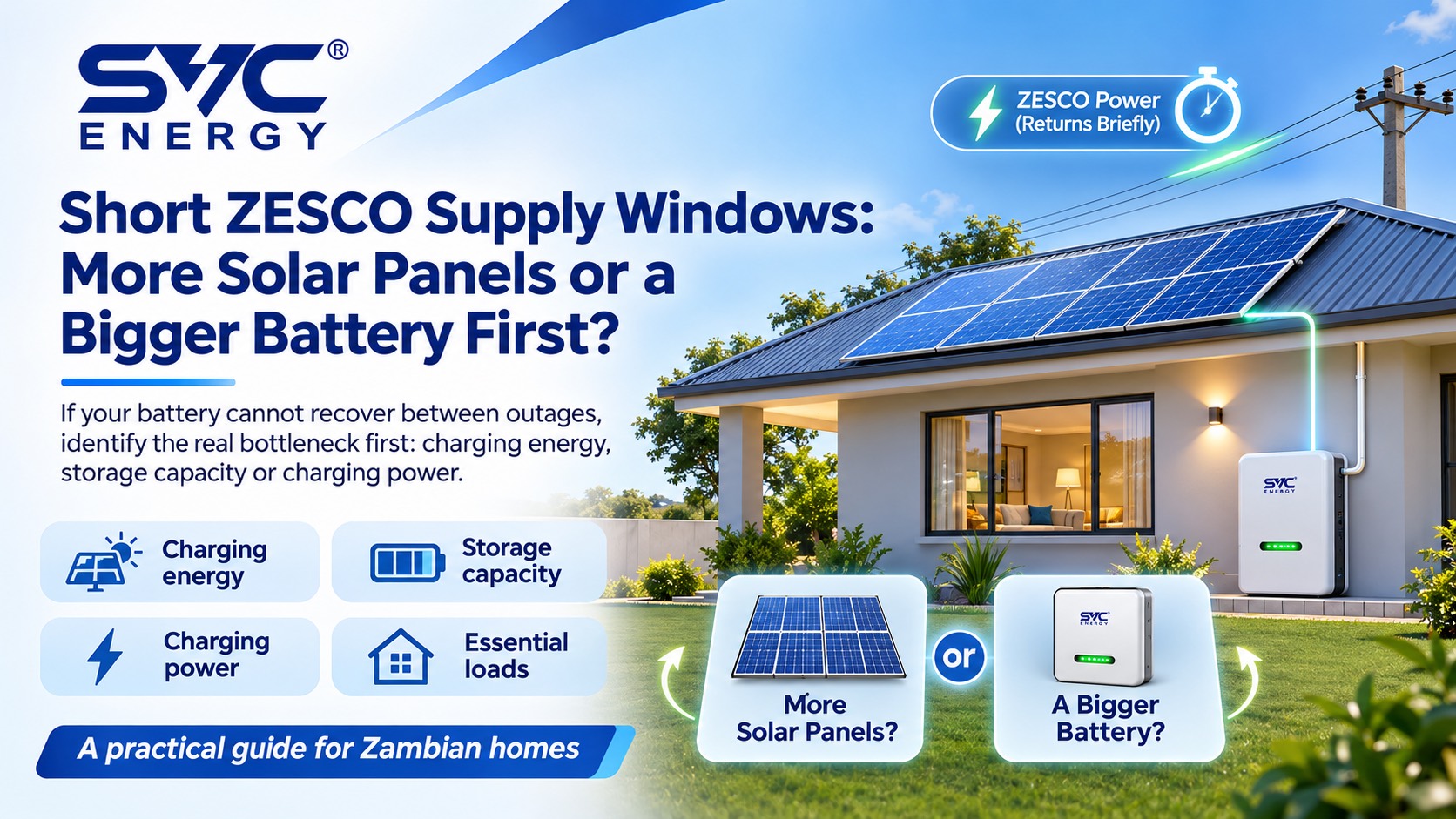
Contact SVC EnergyShort ZESCO Supply Windows: More Solar Panels or a Bigger Battery First?
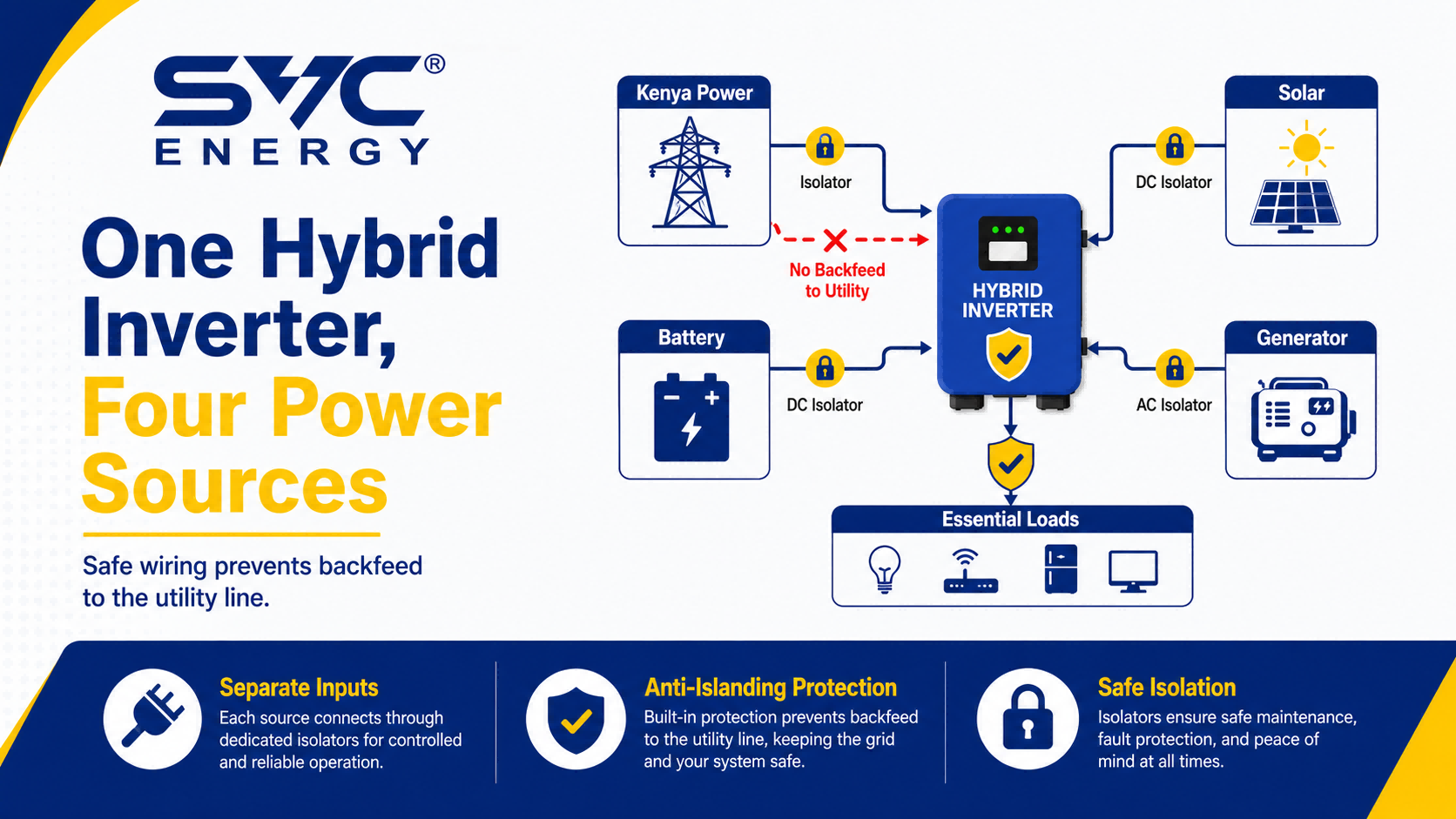
Can a Hybrid Inverter Safely Combine Kenya Power, Rooftop Solar and a Generator?
Related Article