Where Should a Lithium Battery Be Placed in a Zambian House During Hot and Dusty Load-Shedding Season?
Direct Answer
In a Zambian house, a lithium battery should be placed in a cool, dry, ventilated and protected area, such as a utility room, garage corner, indoor service area or covered storage space. It should not be placed under direct sun, near a stove, in a bathroom, outside in rain, beside dusty open windows, or where children can touch cables and switches.
During hot and dusty load-shedding seasons, placement matters almost as much as battery size. A good battery can still perform poorly if it is installed in heat, dust, poor ventilation or unsafe wiring conditions.
Why Battery Placement Matters in Zambia
Zambia’s load-shedding problem is often linked to wider power shortages and hydropower pressure during drought periods. When outages last longer, home batteries may charge and discharge more often. That means the installation environment becomes more important.
A lithium battery is not just a box of energy. It includes cells, BMS protection, communication ports, wiring, breakers and sometimes display or app monitoring. Heat, dust and poor airflow can increase stress on the system. Bad placement can also make maintenance harder when the battery shows an alarm or the inverter trips.
So the question is not only “How many kWh do I need?” It is also “Where will this battery live safely every day?”
Best Places to Install a Lithium Battery at Home
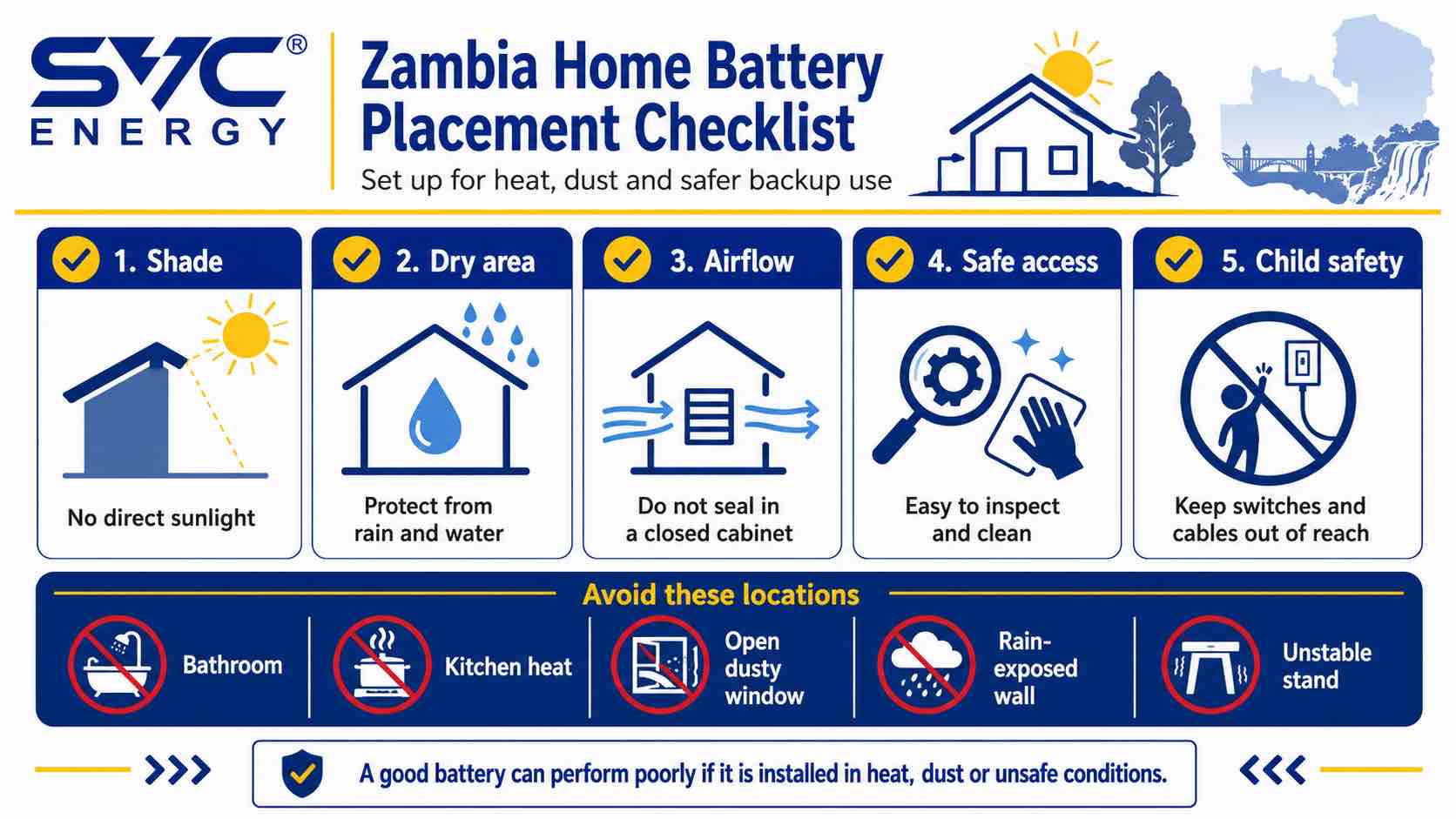
A good location should meet five conditions.
First, it should be shaded. Direct sunlight can heat the battery cabinet and surrounding air. Even if the battery has protection, heat can reduce comfort and increase stress during heavy use.
Second, it should be dry. Avoid bathrooms, laundry splash areas, outdoor walls exposed to rain, and floors where water can collect.
Third, it should have airflow. The battery does not need to sit in the wind, but it should not be locked in a sealed cupboard with no ventilation.
Fourth, it should be easy to inspect. The owner or installer should be able to see the display, check cables, read alarms and clean dust around the unit.
Fifth, it should be away from children and accidental impact. Cables, breakers and battery switches should not be easy for children to touch.
Good placement examples:
Utility room
Garage corner
Indoor service area
Covered veranda only if protected from rain and direct sun
Clean storage room with ventilation
Wall-side floor area near the inverter and distribution board
Places to Avoid
Do not place the battery in direct sun. Even a strong battery system should not be baked all day against a hot wall or metal roof.
Do not place it beside a stove, oven or cooking area. Cooking heat, smoke and oil are bad for electronics and battery cabinets.
Do not place it in a bathroom or wet area. Moisture and electrical systems are a poor combination.
Do not place it on an unstable stand. A heavy lithium battery should sit on a stable floor or approved mounting system.
Do not place it where dust blows directly into the unit every day. In dusty homes, leave space for cleaning and inspection.
Do not hide it behind furniture where the installer cannot access the battery, cables or protection devices.
Floor-Standing Battery or Wall-Mounted Battery?
For some Zambian homes, a floor-standing lithium battery is more practical than a wall-mounted unit, especially when the battery is heavy or the wall strength is uncertain.
SVC’s 16.08kWh LiFePO4 battery uses a 51.2V / 314Ah configuration and is designed as a floor-standing battery. It also includes flexible swivel wheels, which can help with movement and positioning during installation. This does not mean the battery should be moved around casually after commissioning, but it can make installation and placement easier.
A wall-mounted battery can be good in homes with strong walls, limited floor space and professional installation. But the installer must confirm the wall structure, mounting hardware and cable route.
For larger home backup or small-business backup in Zambia, floor-standing storage can be easier to place, inspect and expand, especially if the buyer may later add more capacity.
How Close Should the Battery Be to the Inverter?
The battery should usually be close enough to the inverter to keep cable runs practical and safe. Long cable runs can increase voltage drop, installation cost and wiring complexity.
Ask the installer:
Where will the inverter be mounted?
How long will the battery cables be?
Are the cable sizes correct for the current?
Are DC breakers or protection devices included?
Can the battery communicate properly with the inverter?
Can I see battery status through an app, screen or BMS indicator?
Good placement is not only about the room. It is also about the full system layout.
Dust and Heat Checklist for Zambian Homes
Before approving the installation, check:
The battery is not in direct sunlight.
The area is dry and protected from rain.
There is enough space around the battery for airflow.
The floor is stable and level.
Children cannot easily reach switches or cables.
Dust can be cleaned without moving the system.
The inverter and battery are close enough for safe wiring.
The installer has included proper protection devices.
The battery display or app can be checked easily.
The owner knows what BMS alarms mean.
If the installer cannot explain these points, ask for a better placement plan before installation.
What About Outdoor Installation?
Outdoor installation should only be considered if the product and enclosure are designed for that environment. Many home lithium batteries should be installed indoors or in protected areas, not exposed directly to rain, sun and dust.
If outdoor placement is unavoidable, the installer should confirm enclosure rating, shading, waterproofing, ventilation, cable protection and local electrical requirements. Do not assume that any battery can be installed outside just because it looks strong.
Conclusion
During Zambia’s hot and dusty load-shedding season, a lithium battery should be placed where it can stay dry, shaded, ventilated, stable and easy to inspect. Avoid direct sun, water, cooking heat, dust build-up, unstable supports and locations where children can touch the system.
For heavier home backup needs, a floor-standing battery such as SVC’s 16.08kWh LiFePO4 model can be practical when installed in a clean, protected indoor or utility space. But the final placement should always be confirmed by a qualified installer based on cable length, inverter position, ventilation and safety protection.
For a Kenyan Milk Bar or M-Pesa Shop, Is Battery Backup Cheaper Than Losing Sales During Outages?
Which Solar Battery Packages Should Nigerian Distributors Prepare for Homes, Clinics and Phone Charging Shops?
Related Article