What Size of Solar Battery Do I Need to Survive a 14-Hour ZESCO Load Shedding with a Fridge?
The Quick Answer
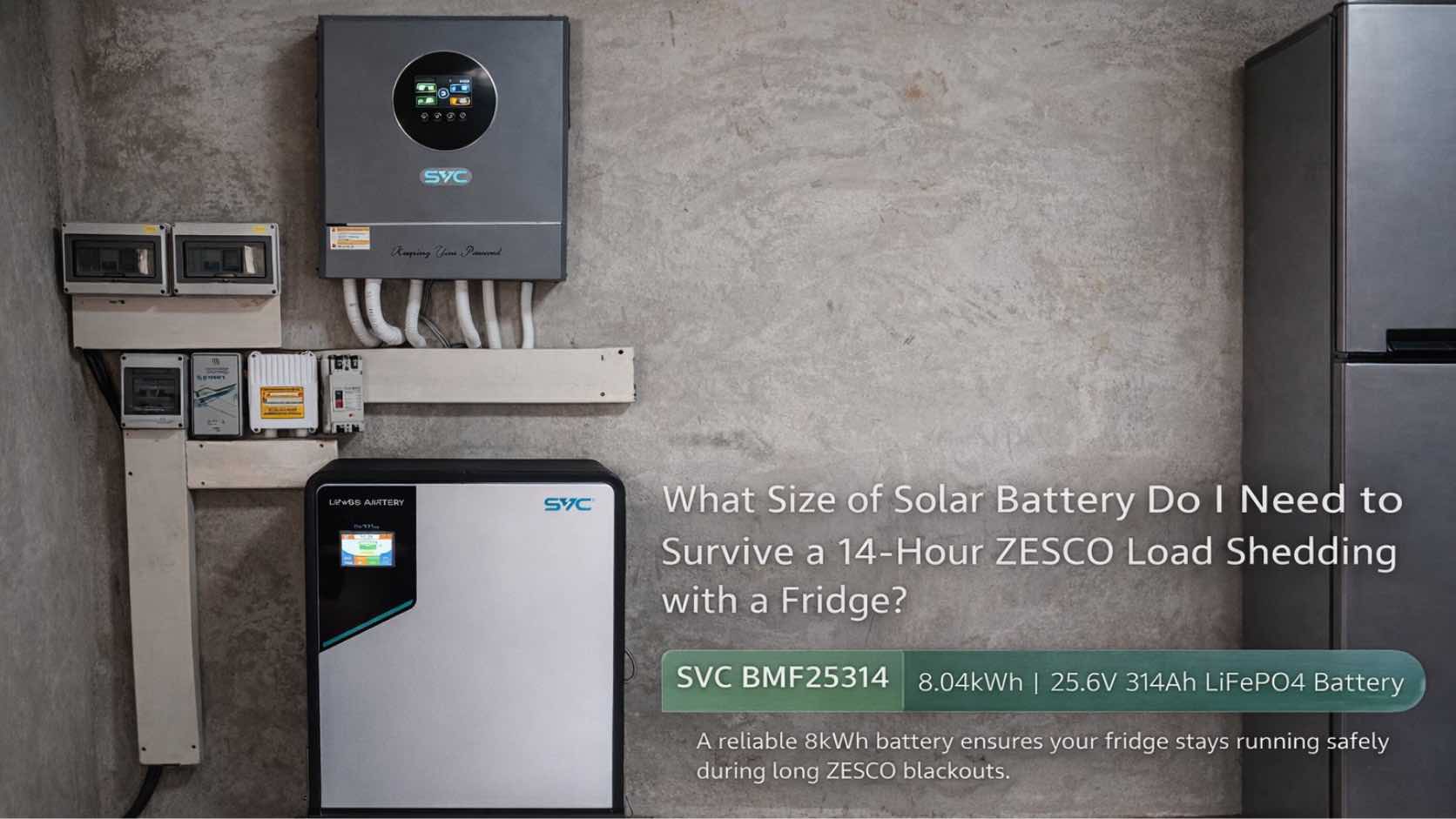
If you live in Lusaka and need to keep a standard fridge, a TV, Wi-Fi, and lighting running through a 14-hour ZESCO load shedding window, a small 2kWh or 3kWh setup will leave you in the dark. To safely cover this duration without killing your battery's lifespan, your baseline should be an 8kWh LiFePO4 (Lithium Iron Phosphate) battery. For this specific scenario, we strongly recommend a high-capacity residential module like the SVC BMF25314 (8.04kWh, 25.6V 314Ah). It provides enough usable energy to survive the long blackout and, crucially, can accept a massive charge current to refill itself quickly when the power briefly returns.
The Math: Calculating Your 14-Hour Survival Load
Many homeowners buy a battery based on the total wattage of their appliances, but they forget to factor in time and inverter inefficiency. Here is the realistic breakdown of what happens during a 14-hour blackout:
-
The Fridge (The Silent Drainer): A modern inverter fridge uses about 150W when the compressor is running. Assuming it cycles on and off (running 50% of the time), it consumes about 75W per hour.
-
75W x 14 hours = 1,050Wh (1.05kWh)
-
-
Entertainment & Connectivity: A 55-inch LED TV, DSTV decoder, and Wi-Fi router pull roughly 120W combined. If you use them for 6 hours during the blackout:
-
120W x 6 hours = 720Wh (0.72kWh)
-
-
Lighting & Phone Charging: Five LED bulbs (10W each) and phone chargers pull about 70W. Left on for 6 hours:
-
70W x 6 hours = 420Wh (0.42kWh)
-
-
Inverter Self-Consumption: Your hybrid solar inverter needs power just to stay awake and convert DC to AC. This can easily consume 50W per hour.
-
50W x 14 hours = 700Wh (0.7kWh)
-
Total Expected Energy Draw: ~2.89 kWh.
Why recommend an 8kWh battery for a 3kWh load? Because of the "Recharge Window" constraint. In Zambia, you might only get grid power for 4 to 6 hours. If it's a cloudy day and solar panels aren't producing much, you need a larger battery buffer to store excess grid power quickly. Furthermore, draining a lithium battery to 0% every single day (100% Depth of Discharge) adds unnecessary stress. An 8.04kWh battery like the SVC BMF25314 allows you to use only 40% of its capacity during a 14-hour stretch, ensuring it easily lasts its designed 10+ year lifespan.
The "Do Not Touch" Checklist During Load Shedding
Even with an 8kWh battery, 14 hours is an endurance marathon. To protect your system from tripping, you must separate your "Essential Loads" from your "Heavy Loads." If the grid is off, absolutely do not attempt to run the following appliances on your backup battery:
-
Electric Geysers (Water Heaters): These draw 3000W to 4000W continuously and will drain your entire battery in under two hours.
-
Microwaves & Air Fryers: The heating elements pull massive amounts of current.
-
Electric Irons & Kettles: A standard kettle pulls 2000W. Boil water on a gas stove instead.
Local Sourcing: Ready Stock in Zambia
When ZESCO schedules dictate your life, waiting weeks for a battery shipment is incredibly frustrating. The SVC BMF25314 (8.04kWh) and larger BMF51314 (16.08kWh) modules are currently available in our local Zambian distribution network. Sourcing locally means you bypass border delays, secure authentic high-grade LiFePO4 cells, and gain immediate access to our local technical support team to ensure your inverter is programmed with the correct charging parameters for Zambia's unique grid challenges.
Where to Buy Genuine Grade-A 10kWh LiFePO4 Batteries in Lagos Without Getting Scammed?
Where to Buy a Reliable 5kWh Lithium Battery with Same-Day Delivery in Nairobi?
Related Article