What Solar Battery System Can Run a Rural Kenyan Home, Water Pump and Security Lights Off-Grid?

Direct Answer
A rural Kenyan home that needs to run household loads, a water pump and security lights without relying on the grid should use a solar battery system with enough PV panels for daytime charging, a hybrid inverter Kenya setup for power control, and a lithium battery bank sized for night use and cloudy-day backup. The water pump must be calculated separately because its starting surge can be much higher than its normal running power.
For many rural homes, the safest approach is not to buy the cheapest inverter or battery first. Start with the load list, backup hours and pump size, then compare solar inverter price in Kenya, inverter price in Kenya, solar battery prices in Kenya and solar panel prices in Kenya based on the full system requirement.
What Loads Should a Rural Kenyan Solar System Cover?
A rural off-grid system normally supports three groups of loads.
The first group is essential home power: lights, phone charging, radio, TV, router, small fridge and basic sockets. These loads are usually predictable and can be managed with a properly sized battery.
The second group is water pumping. This is the load that often causes problems. A pump may run for a short time, but it can demand high starting current. If the inverter is too small, the system may trip even when the battery still has energy.
The third group is security and outdoor power: gate lights, CCTV, motion lights, electric fence controllers and compound lighting. These are often used at night, so they depend heavily on battery capacity.
If the home also needs an iron, kettle, cooker, welding machine or large freezer, those loads should be separated or used only when solar production is strong.
How to Size the Battery Without Guessing
Battery sizing should begin with nighttime energy demand. For example, lights, TV, phone charging, router and security lights may run for several hours after sunset. A fridge may cycle on and off through the night. A water pump may run during the day, but some homes also need morning or evening pumping.
A small battery may work for lighting, but it may not be enough for a rural home with a pump and security lighting. This is why buyers comparing lithium battery price in Kenya or 200Ah battery price should look beyond amp-hours. A 200Ah solar battery can mean different usable energy depending on voltage, chemistry, depth of discharge and inverter efficiency.
For modern off-grid homes, LiFePO4 lithium batteries are often a better long-term option than basic lead-acid batteries because they support deeper usable capacity, longer cycle life and stronger battery management when designed correctly. SVC standalone LiFePO4 batteries use Grade A cells, smart BMS management, app monitoring support and wide inverter compatibility. For a home that needs longer backup, SVC 10.5kWh or 16.08kWh lithium battery options are more suitable than a very small battery pack.
What Size Hybrid Inverter Is Needed?
The inverter must handle both continuous loads and starting surge. This is especially important for water pumps, fridges and freezers.
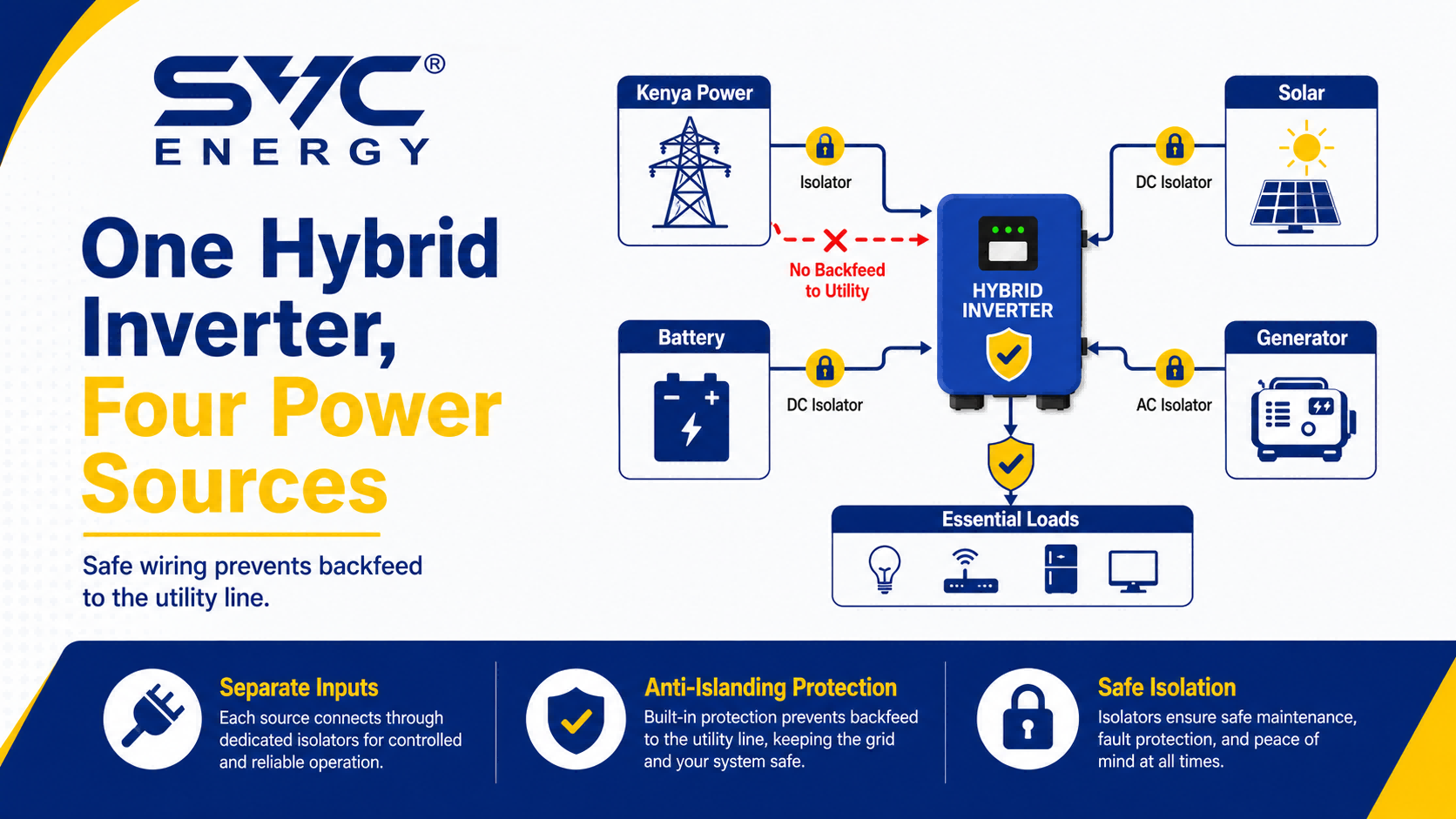
A rural Kenyan home should choose a hybrid inverter that can:
Run essential household loads without overload.
Start the water pump reliably.
Charge batteries from solar panels efficiently.
Protect the battery from over-discharge.
Support future battery or solar panel expansion.
Work with lithium battery communication where possible.
SVC hybrid inverter models include features such as wide MPPT voltage range on applicable models, lithium battery activation, no-battery operation on supported models, and dust filter design for harsh environments. These features are useful in rural Kenyan installations where sunlight, dust, load changes and maintenance access can vary.
Why KPLC Token Delay Backup Power Still Matters
Even if the home wants to operate off-grid, many Kenyan buyers still keep KPLC as a secondary supply where available. In rural areas, KPLC token delay backup power is a real concern because a delay in token purchase, meter update or grid availability can interrupt daily life.
A solar battery system reduces dependence on KPLC tokens by keeping essential loads powered from solar and battery storage. If the system is hybrid and connected correctly, it can use solar first, battery second and grid only when needed. For off-grid homes with no reliable grid access, the same design logic applies, but the battery and PV array must be sized more conservatively.
What Should Buyers Check Before Comparing Prices?
Many buyers search for solar inverter price in Kenya, inverter price in Kenya, solar battery prices in Kenya, lithium battery price in Kenya and solar panel prices in Kenya before speaking to an installer. That is useful, but price comparison only works when the system scope is the same.
Before accepting a quotation, ask these questions:
What loads will the system run during the day?
What loads will run at night?
What is the pump wattage and starting surge?
How many hours should the battery support the home?
What battery chemistry is included?
What is the real battery capacity in kWh?
Is the quoted battery a 200Ah solar battery, and at what voltage?
Does the battery include BMS protection?
Is the inverter a hybrid inverter or only a basic off-grid inverter?
Are breakers, surge protection, earthing, mounting and cables included?
Will the installer separate pump loads from essential household loads?
Is monitoring included for battery and inverter status?
The best solar battery in Kenya is not simply the cheapest battery. It is the battery that matches the inverter, load profile, installation environment, backup-hour target and long-term service plan.
Practical System Direction for a Rural Kenyan Home
A good rural solar backup design should separate loads by priority.
The first priority should be lighting, phone charging, router, TV, security lights and essential sockets. These should stay on even during cloudy weather.
The second priority should be the fridge or freezer, if the home uses one. This requires enough inverter surge capacity and stable battery output.
The third priority should be the water pump. If possible, pump water during strong sunlight and store water in a tank. This reduces pressure on the battery at night.
The fourth priority should be non-essential appliances. Irons, kettles, cookers and heavy tools should be managed carefully or kept outside the backup circuit.
For homes that want simpler installation, an all-in-one energy storage system can reduce wiring complexity because the inverter and battery communication are pre-matched. For homes with higher loads or future expansion plans, a separate hybrid inverter and modular lithium battery system may be more flexible.
Soft Product Recommendation
For a rural Kenyan home with daily lighting, phone charging, Wi-Fi, security lights and occasional water pumping, an SVC hybrid inverter paired with SVC LiFePO4 battery storage can be a practical off-grid or hybrid solution when properly sized.
For smaller homes, a compact all-in-one system may be suitable if the pump load is modest. For larger rural homes, farms or homes with bigger pumps, SVC 10.5kWh or 16.08kWh lithium batteries provide a stronger direction for longer backup. The final configuration should be confirmed through a load audit, pump specification, solar panel layout and required backup hours.
FAQ
Can one solar battery run a rural home and water pump in Kenya?
Yes, but only if the battery and inverter are sized for both energy use and pump starting surge. A small battery may run lights but fail when the pump starts.
Is a 200Ah solar battery enough for a rural Kenyan home?
It depends on voltage, battery chemistry and load. A 200Ah battery may be enough for basic lighting and phone charging, but it may be too small for a pump, fridge and security lights running through the night.
Why do solar battery prices in Kenya vary so much?
Prices vary because battery chemistry, capacity, BMS quality, warranty, brand, installation scope and included accessories differ. Always compare usable kWh, not only amp-hours.
Should I buy the cheapest inverter in Kenya?
Not if the system must run a pump. A low inverter price in Kenya may look attractive, but an undersized inverter can trip when the pump or fridge starts. Surge capacity and battery compatibility matter.
Can solar fully replace KPLC in a rural home?
Yes, in some homes, but the system must be sized carefully for cloudy days, nighttime loads and water pumping. Many buyers still keep KPLC or generator backup where available for extra resilience.
How to Save ZESCO Prepaid Units When Using an Inverter and Solar Battery at Home
Why Does My Inverter Shut Down When ZESCO Power Comes Back or When the Fridge Starts?
Related Article