Is There Demand for Solar-Powered Battery Swap and Second-Life Storage Products in Kenya?

Kenya's Battery-Swap Market Is No Longer Just an EV Story
Kenya is becoming one of Africa’s most active markets for electric motorcycles and battery-swapping networks. The demand is not only coming from climate policy or startup funding. It is coming from riders who need cheaper daily transport, faster battery access, and more reliable swap points outside a few busy urban zones.
This matters for solar and storage suppliers because every battery-swap station is also an energy site. It needs power conversion, battery charging, backup storage, monitoring, safety protection, and sometimes solar generation to reduce grid dependence. As the network expands, the opportunity moves from “selling EV batteries” to building distributed energy infrastructure.
For solar-powered battery swap and second-life storage products, Kenya shows early but serious demand.
Market Signal 1: Riders Are Asking for More Swap Access
A recent AP report from Nairobi highlighted a very practical problem: electric motorcycle riders want battery networks that work in more places and across more brands. Some riders reported losing income when they cannot find a swap point or when a battery network is too restricted.
That is a strong demand signal. Riders are not asking for abstract clean energy. They are asking for:
- more swap stations;
- faster access to charged batteries;
- less waiting time;
- fewer brand-locked systems;
- better coverage beyond city centers;
- lower operating cost than petrol motorcycles.
For investors and distributors, this means the product opportunity is not only the motorcycle. The bigger bottleneck may be the charging and swapping infrastructure behind it.
Market Signal 2: Capital Is Moving Into African Battery-Swapping Networks
In June 2026, AP reported that Spiro raised $215 million to expand electric mobility and battery-swapping infrastructure across Africa. The company operates in Kenya and several other African markets, and the report noted more than 100,000 electric vehicles and 2,500 smart battery-swapping stations across its active markets.
That does not automatically mean every solar-storage supplier should enter Kenya tomorrow. But it does confirm that large investors see battery swapping as infrastructure, not a small pilot business.
The same report also mentioned expansion areas such as solar-powered swap stations, battery storage, local manufacturing, and battery recycling. These are exactly the areas where solar-plus-storage companies can participate without becoming motorcycle manufacturers.
Where Solar-Powered Swap Stations Make Sense
Solar-powered battery swap stations are most attractive where electricity access is costly, unreliable, or capacity-constrained. In Kenya, the strongest early locations are likely to be:
- motorcycle taxi corridors;
- peri-urban transport hubs;
- delivery rider zones;
- market centers;
- campuses and industrial parks;
- areas where grid connection is available but not strong enough for fast charging;
- future rural mobility corridors where grid power is less dependable.
Solar does not need to cover 100% of station energy demand to be useful. Even partial solar generation can reduce daytime charging cost, lower grid pressure, and provide a stronger green-energy story for investors.
A practical solar swap station may combine PV, grid input, battery charging cabinets, stationary storage, energy management, and remote monitoring. The challenge is not only installing panels. The real challenge is matching charge schedules, rider demand peaks, battery inventory, and site power limits.
Why Second-Life Storage Is a Separate Opportunity
Second-life storage means using batteries that are no longer ideal for mobility but still useful for stationary energy storage. In Kenya’s e-mobility market, this could become important as electric motorcycle fleets age.
A motorcycle battery may become less attractive for daily riding when its capacity drops, but it may still have value in a lower-stress stationary application if tested, graded, protected, and managed correctly.
Possible second-life storage applications include:
- backup power for swap stations;
- solar energy buffering;
- low-power lighting and security loads;
- telecom or kiosk backup;
- small commercial storage;
- rural energy hubs.
But second-life storage should not be marketed casually. It requires battery testing, state-of-health grading, thermal protection, BMS integration, fire-safety planning, traceability, and clear warranty boundaries. Without those controls, second-life batteries can become a safety and reputation risk.
Product Opportunity for Solar and Storage Suppliers
For a company like SVC Energy, the Kenya opportunity is not necessarily to sell a “battery swap product” immediately. The stronger entry angle may be supporting infrastructure around swap networks and distributed energy sites.
Relevant product directions include:
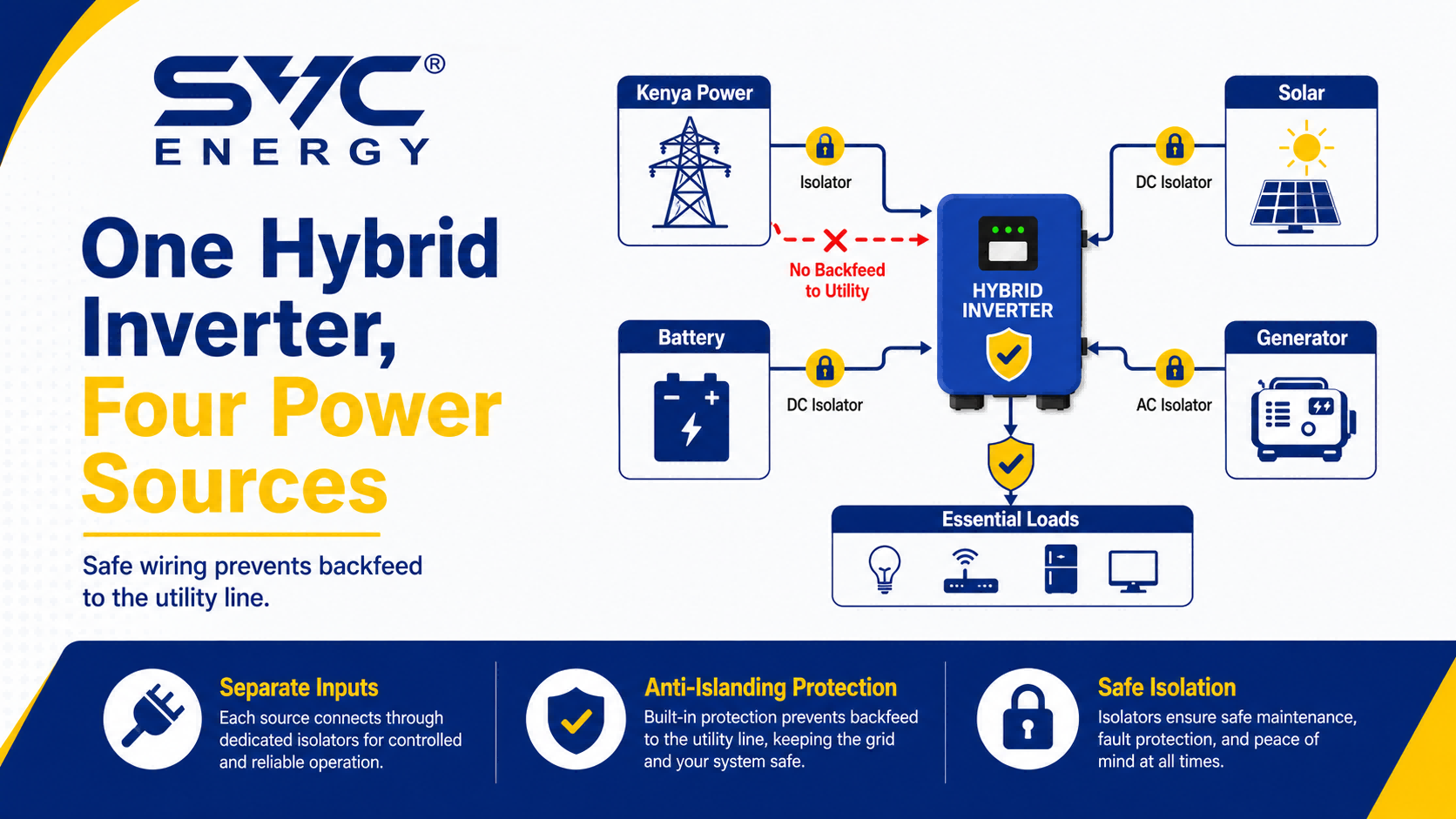
- hybrid inverters for solar, grid, and generator input;
- modular LiFePO4 battery banks for station backup;
- all-in-one energy storage systems for smaller swap or charging locations;
- remote monitoring for distributed station networks;
- expandable battery storage for future demand growth;
- C&I inverter solutions for larger depots or charging hubs.
SVC’s product library already includes hybrid inverters, standalone lithium batteries, and all-in-one systems that fit backup and distributed energy use cases. For example, SVC lithium batteries use LiFePO4 chemistry, smart BMS management, app monitoring, and parallel expansion. These features are relevant for stationary backup around swap stations, although a dedicated battery-swap cabinet product would need separate technical confirmation.
What Investors Should Check Before Entering This Market
The demand is real, but the market is not simple. Before investing in solar-powered swap stations or second-life storage in Kenya, the key questions are:
- Can the station serve enough riders per day to justify the site cost?
- Is the battery system brand-locked or interoperable?
- Who owns the battery: rider, operator, financier, or fleet company?
- What happens when a battery fails, degrades, or is misused?
- Can solar reduce energy cost enough to improve station economics?
- Is there enough space and security for PV, cabinets, and storage?
- Can the system be monitored remotely?
- Are fire safety and battery handling procedures clear?
- Is second-life storage certified, tested, and insurable?
The biggest risk is assuming that battery swapping demand automatically creates profitable infrastructure. Station location, battery standardization, financing model, and operations discipline will decide the outcome.
What Solar Battery Products Are Easiest for Nigerian Distributors to Sell to Homes and Small Shops in 2026?
Can I Add Lithium Batteries to My Existing Solar Inverter During Load Shedding in Zambia?
Related Article