How Should a Business Compare a Solar PPA With Buying Its Own Battery Storage in Zambia?

Solar PPA vs Buying a Solar-and-Battery System in Zambia: Which Is Better for Your Business?
A solar PPA can reduce upfront capital spending, while buying a system gives your business more control and potential long-term asset value. The right choice depends on your load profile, outage risk, available capital, expected operating hours, site ownership, financing cost and ability to manage maintenance.
Quick Answer
Choose a solar PPA when preserving capital, outsourcing operations and paying for a defined energy service are more valuable than owning the equipment. Choose self-ownership when your business has the capital, expects to remain at the site for many years and wants more control over design, operation and future expansion. In both cases, compare the same energy, reliability and contract assumptions before deciding.
Start With the Business Problem, Not the Financing Label
A solar PPA and an owned system can both provide solar generation and battery backup. The difference is who pays for, owns and operates the equipment.
Under a typical PPA, a developer funds, owns and may operate the solar-and-storage system. Your business agrees to buy electricity or capacity under a contract, often over several years. This can preserve capital for inventory, expansion or other business needs.
With self-ownership, your business pays for the system directly or finances it. You own the equipment, choose the contractor and control future expansion, but you also take responsibility for performance, maintenance, repairs and replacement planning.
Define the Outcome First
Before comparing prices, decide whether the priority is lower daytime energy cost, fewer production interruptions, reduced generator dependence, protection for sensitive equipment or enough backup to complete a shift during an outage. A system designed only for bill reduction may not deliver the same backup capability as one designed for critical loads.
When Does a Solar PPA Make Sense?
A PPA can be attractive when a business wants predictable energy costs without making a large upfront investment. It may suit a warehouse, workshop, retail site, clinic, school, hotel or factory that has a stable daytime load and can commit to a contract term.
A Strong PPA Proposal Should Explain
- The solar capacity and battery capacity being provided
- Which loads are covered during an outage
- Whether the agreement charges for energy, capacity, availability or a combination
- The tariff structure and how it changes over time
- The minimum purchase commitment
- The expected system uptime and what happens when it is unavailable
- Who performs operations and maintenance
- Who pays for repairs, replacement parts, insurance and site restoration
- What happens if the business moves, expands, reduces operations or sells the site
The main benefit is not “free solar.” It is transferring much of the upfront investment and operational responsibility to the provider. The trade-off is that your business may have less control over the equipment and could be committed to a long-term payment structure.
When Does Buying Your Own System Make Sense?
Self-ownership can be suitable when a business has capital available, expects to stay at the site for many years and wants control over design, operation and future expansion.
An owned system may be more flexible if your load is likely to change. For example, a workshop may add compressors, a farm may add pumps, or a small factory may increase production hours. Ownership can allow you to expand the battery bank, PV array or inverter capacity when the business case supports it.
However, ownership should not mean buying equipment without a full operating plan. Your budget must include more than panels, batteries and inverters. Include site assessment, electrical upgrades, protection devices, engineering, installation, commissioning, monitoring, maintenance, insurance and a replacement plan for components over the project life.
Three-Phase Commercial Sites Need a Measured Design
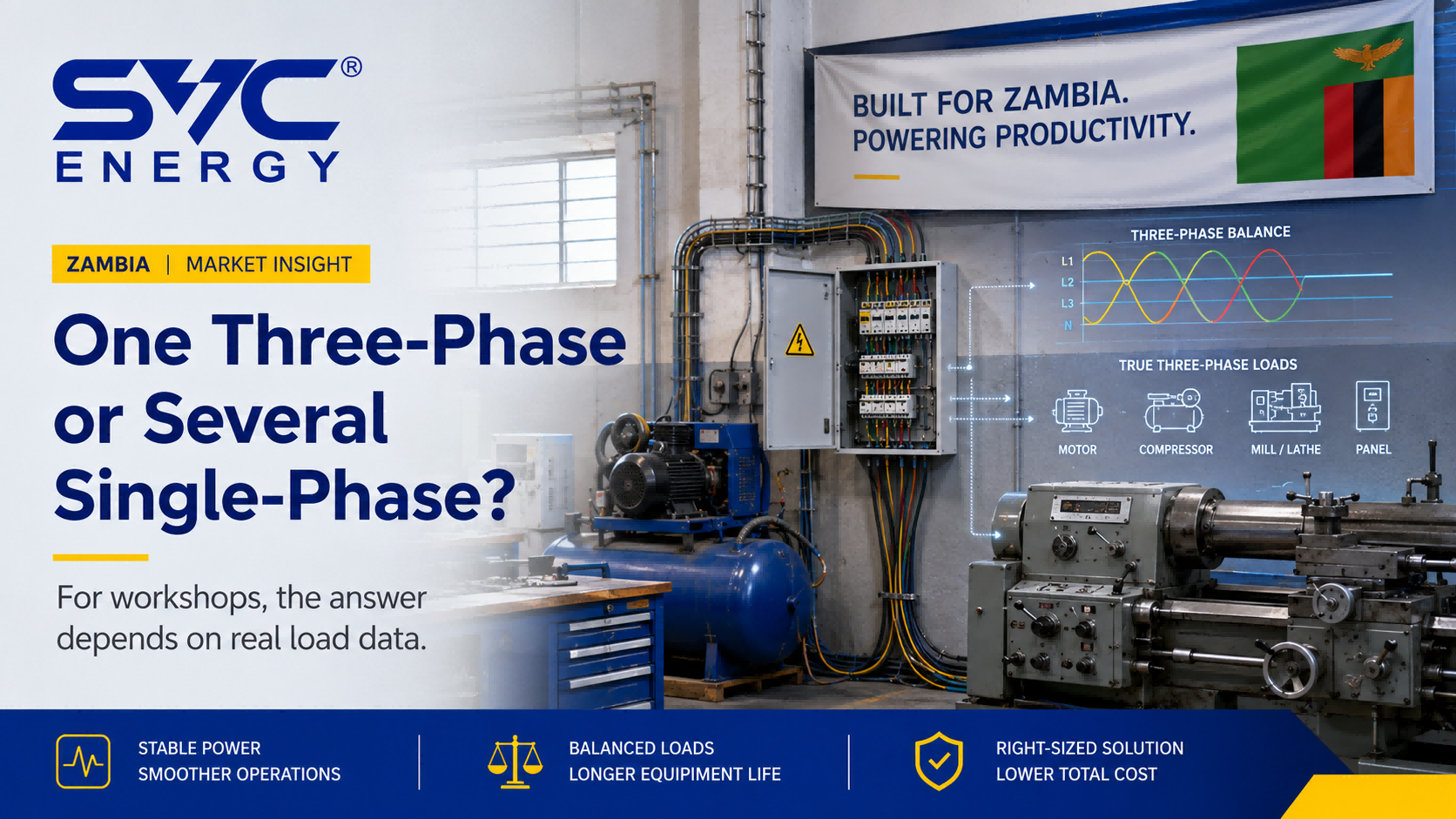
For small commercial sites with three-phase loads, the technical design also matters. SVC’s low-voltage three-phase hybrid inverter range supports grid and diesel-generator access, remote monitoring and multiple operating modes. The 20 kW model supports up to 400 A charging and discharging and can pair with modular low-voltage battery storage. Whether this is appropriate depends on the measured load profile, motor-starting demand and required backup duration—not simply the size of the building.
Compare Reliability, Not Only the Electricity Price
A PPA quotation may look cheaper than ownership if it focuses only on the price per kWh. An ownership proposal may look expensive if it includes a larger battery for outage protection. To make a fair comparison, ask both providers to define the same service level.
- Solar energy delivered during normal operation
- Battery energy available for critical loads during an outage
- Maximum power available at one time
- Treatment of motor starting, pumps, compressors and refrigeration
- Solar, grid and generator charging options
- Monitoring and fault-response process
- Planned maintenance and downtime
- Backup performance during low-solar periods
- Expansion options if demand grows
A business that loses revenue when power fails should also value avoided downtime. This requires a transparent calculation based on actual operating hours, generator fuel use, production losses, staff time and critical equipment requirements. Do not accept a guaranteed payback period unless those assumptions are shown and can be checked.
Questions to Ask Before Signing a PPA
Ask the PPA provider for a draft contract and have it reviewed by qualified commercial and legal advisers. Key questions include:
- Is there a minimum energy purchase or take-or-pay obligation?
- Is the tariff fixed, indexed or subject to escalation?
- Who owns the equipment at the end of the agreement?
- Can the business buy the system early, and how is that price calculated?
- What service level applies if the battery or inverter is unavailable?
- Who is responsible for site access, roof repairs, security and insurance?
- What happens if grid rules, business hours or site ownership change?
- Can the system be expanded, and who approves the upgrade?
- Is the provider responsible for disposal or removal at contract end?
A PPA can be commercially useful, but it should not lock a business into unclear performance obligations or unexpected exit costs.
Questions to Ask Before Buying a System
For self-ownership, request a design and proposal that can be independently reviewed. Ask for:
- A measured or documented load profile
- A clear list of critical and non-critical loads
- Battery capacity stated in kWh and usable-energy assumptions
- Inverter power rating and motor-surge treatment
- PV-array size, orientation, shading assessment and charging assumptions
- Single-line electrical diagram and protection scope
- Monitoring access and commissioning records
- Written warranty responsibilities and local service process
- Annual maintenance plan and expected spare-parts requirements
If the proposal includes financial savings, require the diesel price, generator fuel consumption, grid tariff, operating hours, maintenance cost and system price assumptions used in the calculation.
Match the Financing Structure to the Business Need
Choose a PPA when preserving capital, outsourcing operations and obtaining a defined energy service are more valuable than owning the asset. Choose self-ownership when your business has the capital, wants flexibility, expects a long stay at the site and can manage the operational responsibilities.
In both cases, start with an energy audit and critical-load plan. The best financing structure cannot fix an undersized battery, an overloaded inverter or a poorly commissioned installation.
Planning a Commercial Solar-and-Storage Project in Zambia?
Start with your measured load profile, critical-load requirements, outage pattern and expected operating hours. A clear technical brief makes it easier to compare a PPA and an owned system on equal terms.
Contact SVC EnergyWhat Monitoring Data Should a Kenyan Business Review Before a Solar-Battery Fault Becomes Downtime?
Which Inverter Alarms Should I Understand Before Calling a Solar Technician in Nigeria?
Related Article