Why Your Factory Solar Inverter Keeps Tripping (And How Dual AC Outputs Fix It)

The 1-Second Diagnosis: Why The Trip Happens If you run a manufacturing business in Ikeja or Kano, you already know the frustration: the national grid collapses, your solar system kicks in perfectly, but the moment a heavy factory machine (like a compressor or industrial motor) is switched on, the entire inverter trips. Suddenly, your office computers go black, servers crash, and productivity hits zero.
The immediate answer to your problem is not to spend millions of Naira buying a massively oversized battery. The root cause is the "startup surge" (inrush current) of heavy inductive loads. To fix this permanently without blowing your budget, you need an intelligent energy management feature called Dual AC Outputs, which mechanically and smartly separates your essential office power from your heavy factory equipment.
Inductive Surges vs. Smart Load Separation Let’s do the math on why standard inverters fail in a Nigerian industrial setup.
Standard electrical appliances (like office lights or laptops) are resistive loads—they draw a constant amount of power. However, factory machines with motors are inductive loads. A machine that runs at 2kW might require a massive 6kW to 8kW surge for the first 3 seconds just to start the motor.
When a standard inverter detects this sudden spike, its built-in safety mechanism perceives it as a short circuit or an overload. To protect the system from burning, the inverter trips, shutting down everything connected to it.
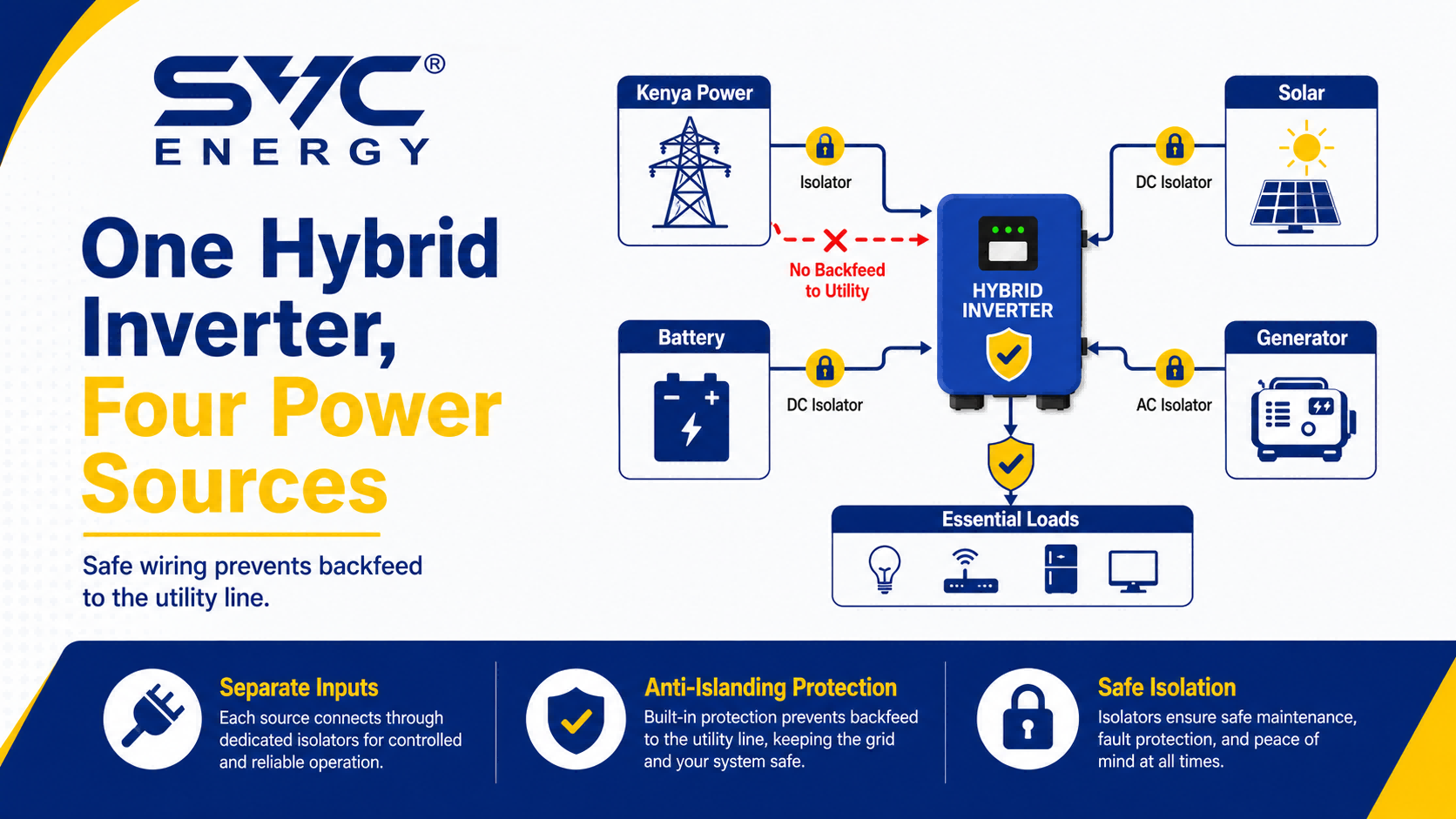
The SVC Energy Solution: Instead of forcing all your appliances to share one circuit, SVC Energy’s independent inverters (from 3.5kW to 11kW) and All-in-One systems are engineered with Dual AC Outputs.
-
Primary Output (Essential): Connected to your critical office infrastructure (servers, PCs, security cameras, Wi-Fi).
-
Secondary Output (Non-Essential/Heavy Loads): Connected to the factory floor's heavy motors, ACs, and water pumps.
Through the smart BMS (Battery Management System), you can program the inverter to prioritize the Primary Output. If a heavy machine creates an overwhelming surge, or if your battery capacity drops below a certain threshold (e.g., 20%), the inverter will instantly and automatically shut off the Secondary Output (the heavy machines) while keeping the Primary Output running flawlessly. Your office never loses power, and your inverter never trips.
How to Segregate Your Factory Loads Today To implement this zero-downtime strategy, share this quick checklist with your local installer before deploying an SVC Energy system:
-
Map the Breakers: Separate your Distribution Board (DB) into two distinct sections: Critical (Office) and Non-Critical (Heavy Machinery).
-
Calculate the Surge: Identify the exact startup wattage of your biggest motor. Ensure it falls within the peak surge capacity of your SVC inverter.
-
Wire the Dual Outputs: Connect the Critical DB to the inverter's Primary AC Output, and the Non-Critical DB to the Secondary AC Output.
-
Set the Cut-off Voltage: Use the SVC smart App to set a battery discharge limit that triggers the disconnection of the heavy loads, ensuring you always have enough juice left to safely shut down office servers.
Does Draining Your Solar Battery to 0% Every Day Ruin It? (ZESCO Load Shedding Guide)
Are Second-Hand EV Batteries Safe for Home Solar Storage in Kenya?
Related Article