What Happens If I Connect Too Many Solar Panels to My MPPT Charge Controller?
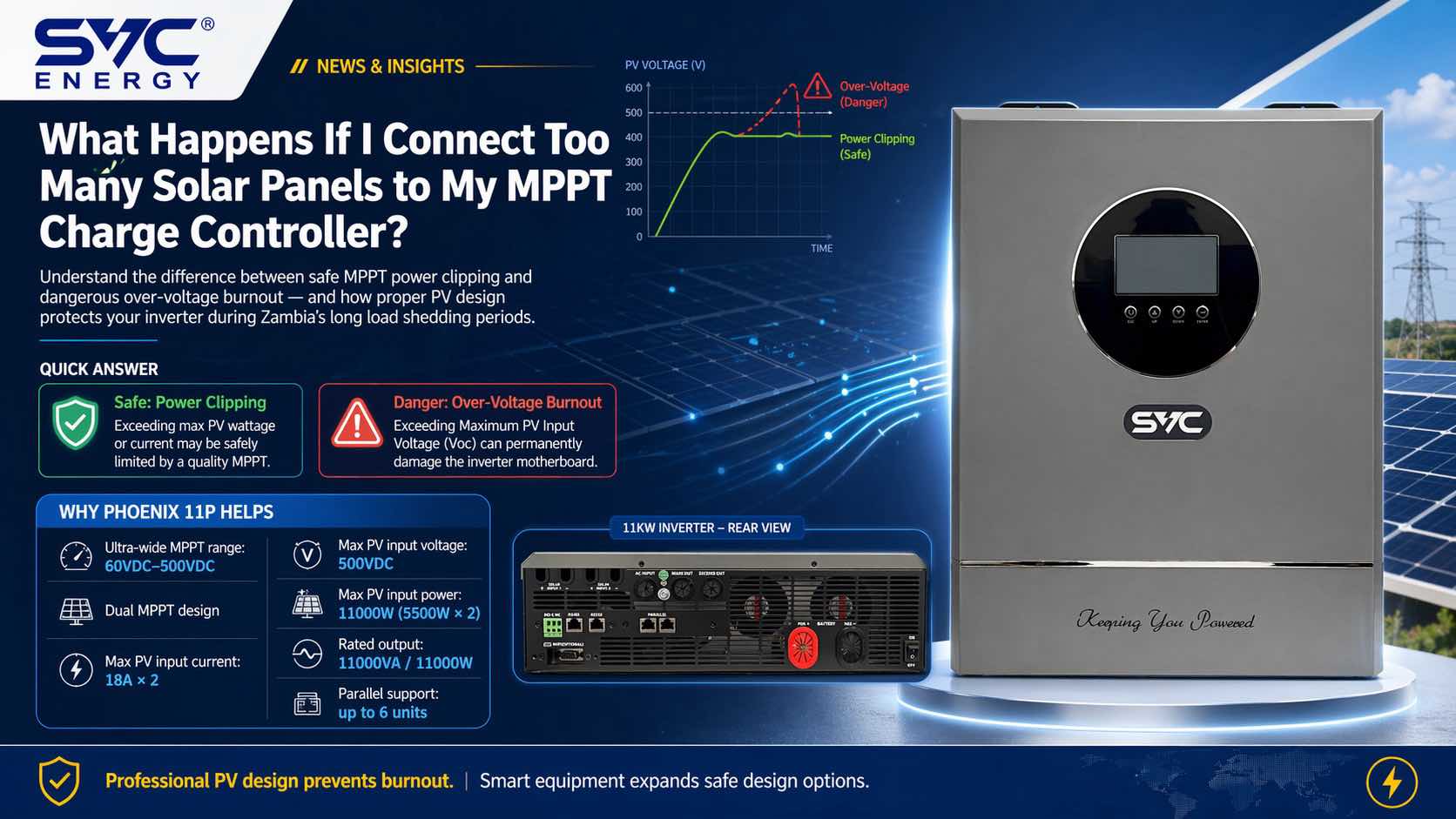
The Quick Answer
If you connect too many solar panels to your MPPT charge controller, one of two things will happen: safe power clipping or permanent catastrophic burnout. The outcome depends entirely on how you wired them. If you exceed the maximum wattage or current rating, a high-quality MPPT will simply limit the excess energy, keeping the system safe. However, if you wire too many panels in a series string and exceed the controller's Maximum PV Input Voltage (Voc), you will instantly fry the motherboard. Exceeding the voltage limit is the number one cause of inverter death in Zambia.
Technical Deep Dive: Voltage Clipping vs. Burnout Risk
To design a safe solar array for long blackouts, installers must understand the difference between "Over-paneling" (which is safe and recommended) and "Over-voltage" (which is fatal).
-
The Safe Zone: Power Clipping (Over-Wattage) "Over-paneling" means installing a solar array whose total wattage is 10% to 20% higher than the MPPT's rated maximum output.
-
What happens? The smart MPPT will execute Voltage Clipping. It actively shifts the operating voltage away from the maximum power point, throwing away the excess power during peak noon sun.
-
Why do it? In Zambia, over-paneling ensures you generate maximum power during early mornings, late afternoons, or the cloudy rainy season to charge batteries much faster.
-
-
The Danger Zone: Motherboard Burnout (Over-Voltage) Every solar panel has an Open Circuit Voltage (Voc). When you wire panels in a series, their voltages add up. If you string too many panels together and hit 160V on a cheap controller rated for only 145V, the internal capacitors will literally explode. Cold weather pushes solar panel voltages even higher, making this extremely dangerous during Zambia's cool season (June/July).
Standard Series-Parallel Design Guidelines for Installers
To eliminate the risk of burnout while maximizing solar yield, follow these rules before climbing onto the roof:
-
Rule 1: Never Exceed the Max PV Input Voltage (Voc Limit)
Always leave a 15% to 20% safety margin for cold weather voltage spikes. If you are using high-power panels, cheap low-voltage equipment severely limits your design options.
-
The Solution: Upgrade to professional-grade equipment. The SVC Phoenix 11P features an ultra-wide MPPT tracking voltage range (60VDC-500VDC) and a massive 500 VDC Maximum PV Input Voltage. This allows installers to safely string multiple large panels in series with zero risk of over-voltage burnout. Furthermore, the extremely low 60VDC startup voltage means the system wakes up and starts generating power early in the morning when light is weak.
-
-
Rule 2: Respect the Max PV Input Current (Isc Limit)
When you wire strings in parallel, the voltage stays the same, but the current multiplies. Cheap single-tracker inverters will easily overheat or clip heavily due to current overload.
-
The Solution: The Phoenix 11P is built with Dual MPPTs (Built-in 2 MPPT) , offering a Max PV Input Current of 18A x 2. This means you can split a massive solar array into two independent inputs (e.g., one facing East for morning sun, one facing West for afternoon sun), perfectly avoiding single-channel current overload and maximizing all-day efficiency.
-
-
Rule 3: Match the Equipment to the True Load and Plan for Expansion Ensure your total PV input power aligns with the hardware limits. The Phoenix 11P supports a Max PV Input Power of 11000W (5500W x 2) and delivers a rated output of 11000VA/11000W, making it the ultimate machine for heavy farm or large villa loads. If more power is needed in the future, it supports parallel connections up to 6 units for seamless expansion.
Are Second-Hand EV Batteries Safe for Home Solar Storage in Kenya?
Where to Buy Genuine Grade-A 10kWh LiFePO4 Batteries in Lagos Without Getting Scammed?
Related Article